
Hyper Software ne hamare business ko online ek nayi pehchan di. Website professional, fast aur SEO optimized hai. Website Design & Development ke liye best company.

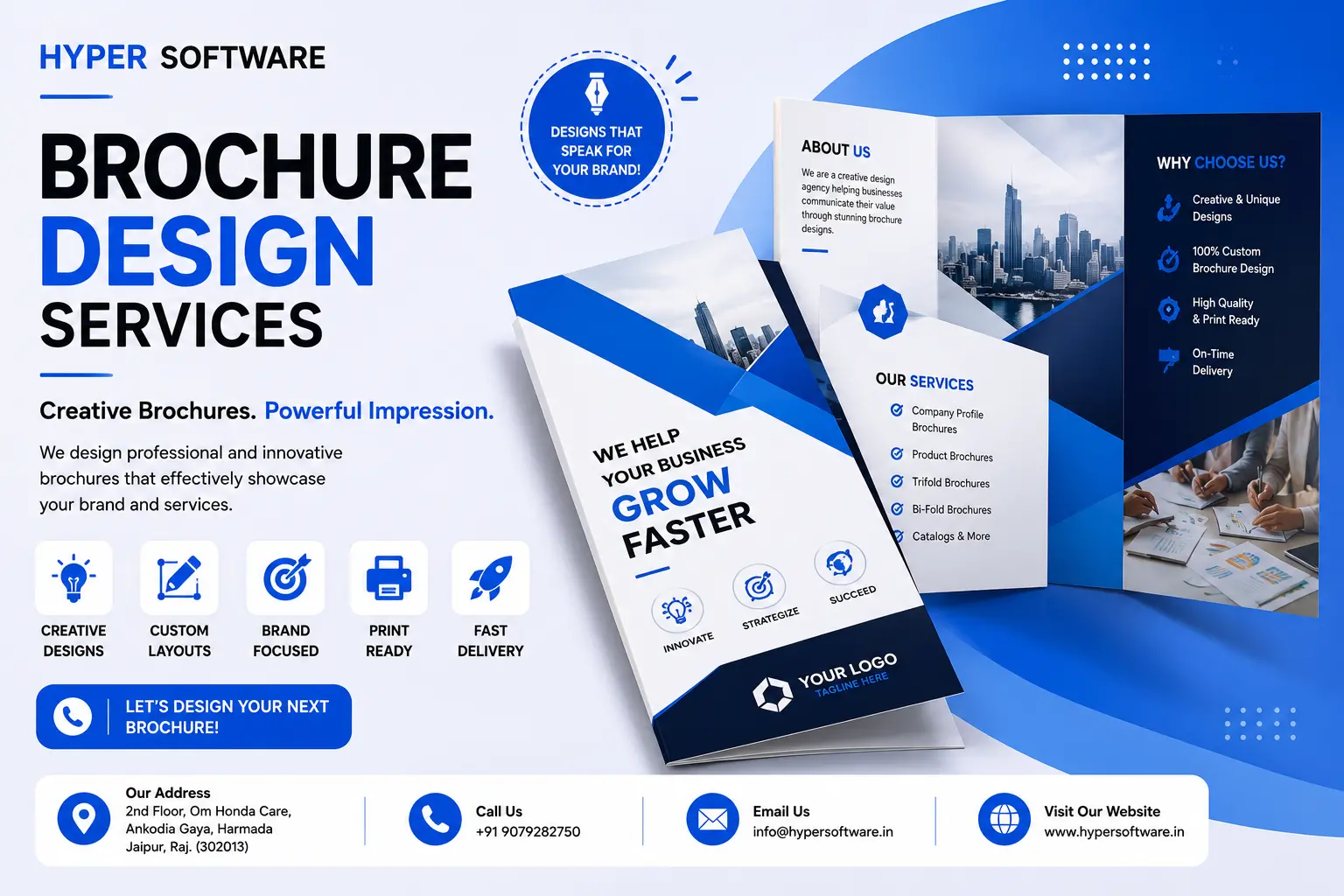
A brochure is still one of the most trusted pieces of marketing a business can hand someone. Unlike a scrolling ad, it sits on a desk, gets passed to a colleague, or stays in a folder until someone's ready to buy. Brochure design is the work of turning your company's story, products, or services into a folded document (print or digital) that people actually want to pick up and read. Hyper Software designs custom brochures for businesses across the globe, from a simple tri-fold for a local clinic to a 20-page product catalog for a manufacturing company. If you've ever tried to build one yourself in Canva or Word and ended up with something that looks close but not quite right, you already know why this matters. Let's get into what good brochure design actually involves, what it costs, and how to avoid the mistakes that make most brochures land in the recycling bin.
Brochure design is the process of planning content, layout, imagery, and typography into a folded document that promotes a business, product, or service. It's part copywriting, part visual design, and part print production. A good brochure has one clear job: get the reader to remember your business and take a next step, whether that's calling, visiting a website, or walking into a store. Here's the part most people miss: brochures didn't stop working when digital marketing took over. Studies on print collateral consistently show that people hold onto physical marketing longer than they engage with a digital ad. A well-designed brochure at a trade show booth, in a doctor's waiting room, or handed over at a sales meeting still does something a scroll-past Instagram post can't. It sits there. It gets picked back up.
Get Free Consultation Within Minutes
The fold you choose isn't just about looks. It decides how much content you have room for, and in what order the reader sees it.
Bi-fold (half-fold) brochure — One fold, four panels. Best for a single strong message, a product launch, or a company overview with big visuals and short copy.
Tri-fold brochure — Two folds, six panels. The most common format. Works well for step-by-step service explanations, event promotions, and general marketing handouts. Fits standard brochure racks and most envelopes.
Z-fold brochure — Also six panels, but the fold moves like an accordion instead of tucking inward. Good for timelines, step-by-step processes, and content that needs to flow left to right without interruption.
Gate-fold brochure — Two smaller panels fold inward to reveal a larger center spread. Creates a dramatic "reveal" effect. Common for premium product launches and real estate.
Multi-page booklet — For catalogs, company profiles, or annual reports where six panels simply isn't enough room.
Digital brochure (interactive PDF) — The same design principles, built for screens instead of paper. Useful for email campaigns and downloadable resources.
Hyper Software ne hamare business ko online ek nayi pehchan di. Website professional, fast aur SEO optimized hai. Website Design & Development ke liye best company.
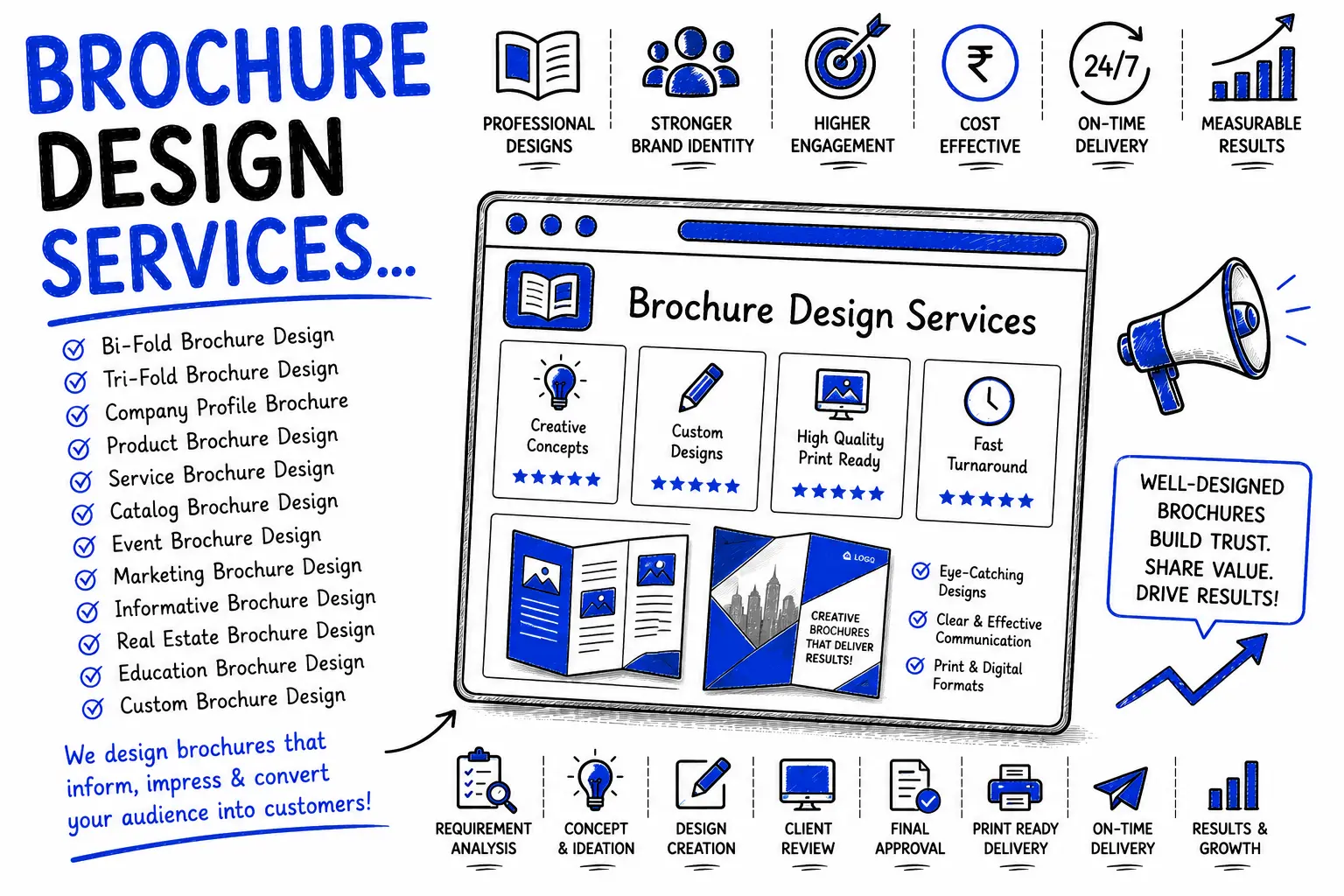
We don't jump straight into layout software. Here's how a project actually runs from start to finish.
Most single-fold and tri-fold projects are delivered in 2 to 4 business days. Multi-page catalogs typically take 1 to 2 weeks depending on page count and content readiness.
Brochure pricing varies more than almost any other design service, mostly because "brochure design" covers everything from a single tri-fold to a 40-page catalog. Here's a realistic breakdown based on current market pricing:
| Project TypeTypical Cost RangeTurnaround | ||
| Basic template customization | $50 - $150 | 1-2 days |
| Custom bi-fold or tri-fold (single project) | $150 - $600 | 2-4 days |
| Corporate brochure with copywriting | $500 - $1,500 | 4-7 days |
| Multi-page booklet or product catalog (10-20 pages) | $1,500 - $5,000 | 1-2 weeks |
| Ongoing design retainer (multiple projects/month) | $400 - $2,000/month | Ongoing |
A few things that push the price up regardless of who you hire: custom illustration instead of stock photography, strict brand guideline compliance, multiple stakeholder revision rounds, and professional copywriting. Printing itself is a separate cost, usually $0.25 to $1.10 per piece depending on paper stock and quantity, and it's worth budgeting for both design and print together so you're not surprised later.
This is worth answering honestly instead of just pushing you toward "hire us."
A simple rule: if the brochure is meant to close deals or represent your company to strangers, hire a designer. If it's a quick internal flyer, a template is fine.
We see the same handful of problems on almost every brochure a client brings us for a redesign.
A mid-size home renovation company came to us with a five-year-old tri-fold brochure. It listed every service they offered in dense paragraphs, had no clear pricing signal, and buried their phone number on the back panel in small text.
We started by asking what the brochure was actually for. Turned out, it was mostly handed out at home shows to people who'd already shown interest, but weren't calling back afterward. So instead of listing every service, we restructured it around three signature services with before/after photos, added a QR code linking to a project gallery, and moved the phone number and a "Get a Free Quote" line to the front cover where it couldn't be missed.
The client tracked call-ins for the next home show using the same booth traffic as the prior event. Callbacks referencing the brochure roughly doubled. Nothing about the company's actual services changed. The brochure just finally did its job: get remembered and get a response.
We've designed brochures across real estate, healthcare and clinics, education and training institutes, restaurants and hospitality, manufacturing and industrial suppliers, financial and insurance services, SaaS and technology companies, and nonprofit organizations. Each industry has different expectations. A clinic brochure needs a calm, trustworthy tone. A SaaS company profile needs to look sharp and technical. We adjust the visual language to match, not just swap logos on a template.
Yes, for quick, low-stakes handouts. Canva struggles with CMYK color accuracy for print and relies on templates used by many other businesses, which can make DIY brochures look generic.
A print-ready PDF set up in CMYK color mode with correct bleed and fold marks is the standard format printers expect. Hyper Software delivers this file with every brochure project.
Yes. Physical marketing materials are often remembered and kept longer than digital ads, especially in trade shows, waiting rooms, and in-person sales meetings. Many businesses now pair a print brochure with a digital PDF version for email and web use.
Your logo, a strong headline or tagline, and one compelling visual. The front cover's only job is to get someone to open the brochure.
Keep each panel under 100 words where possible. Brochures are scanned, not read cover to cover, so short, benefit-focused copy performs better than dense paragraphs.
It helps, but it's not always required. High-resolution stock photography can work if it's chosen carefully and matches your brand tone. Custom photography is worth the investment for brochures used in high-stakes settings like investor meetings.
For mailed brochures, 170-250 GSM matte paper holds up well. For hand-outs and trade shows, 120-170 GSM is usually sufficient and keeps printing costs lower.
Yes. Every project includes a print-ready PDF and a lightweight digital version optimized for email and web sharing, at no extra design cost.
Most Hyper Software brochure packages include unlimited revisions until the client approves the final design. Larger multi-page projects may have a defined revision limit agreed at the start.
At minimum: your business name and logo, a clear description of your services or products, contact information (phone, website, email), and a specific call to action telling the reader what to do next.
Hyper Software has been building digital and design solutions since 2020, working with businesses across websites,graphic design, apps, CRM/ERP systems, and now brand HubSpot — Marketing Collateral Guide like brochures. A few reasons clients stick with us for design work specifically:
If you're ready to get a quote, call us at +91 9079282750 or reach out through hypersoftware.in.
These three get confused constantly, so here's a quick breakdown:
| FormatTypical LengthBest For | ||
| Flyer | Single page, no fold | One-time promotions, quick announcements |
| Brochure | Folded, 4-8 panels | Ongoing use, service overviews, product info |
| Company profile | Multi-page booklet | Investor decks, formal introductions, tenders |
If you're not sure which one fits your need, tell us what you're trying to achieve and we'll recommend the right format before quoting.
Brochure design is the process of planning layout, copy, and visuals into a folded print or digital document that promotes a business, product, or service. It combines copywriting, graphic design, and print production into one deliverable.
Most small business brochures cost between $150 and $1,500, depending on page count, whether copywriting is included, and how much customization is involved. Multi-page catalogs can run $1,500 to $5,000 or more.
A single bi-fold or tri-fold brochure typically takes 2 to 4 business days. Multi-page booklets or catalogs usually take 1 to 2 weeks depending on content readiness and revision rounds.
Standard letter size (8.5" x 11") is the most common for tri-fold and bi-fold brochures in the US, while A4 is standard in most other countries. The right size depends on your fold type and how the brochure will be distributed.
A bi-fold has one fold and four panels, giving more room per panel for large visuals. A tri-fold has two folds and six panels, better suited for step-by-step content and fitting into standard racks.
Have questions or need expert guidance? Our team is ready to help you with the right technology solutions for your business.