
Hyper Software ne hamare business ko online ek nayi pehchan di. Website professional, fast aur SEO optimized hai. Website Design & Development ke liye best company.

Your website just crashed during your biggest sale of the year. Or maybe it didn't crash — it just got painfully slow, right when it mattered most. If that sounds familiar, shared hosting has probably taken you as far as it can.
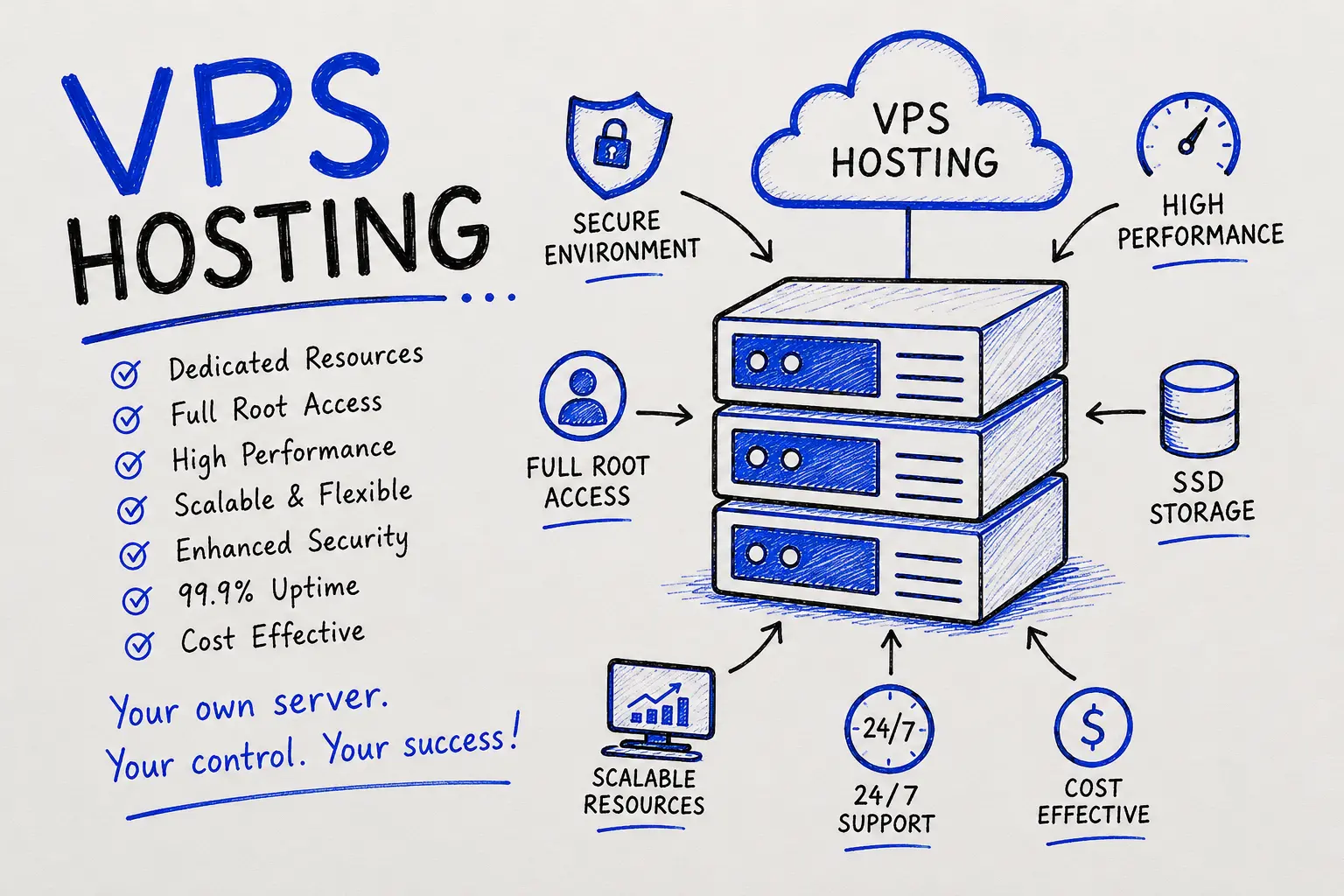
VPS hosting gives your website its own dedicated slice of a server — separate CPU, RAM, and storage that nobody else touches — so your site stays fast and stable even when traffic spikes. Hyper Software builds and manages VPS hosting for businesses that have outgrown shared hosting but aren't ready to pay for an entire dedicated server.
We've been setting up and managing servers for clients since 2020, from small business websites to full eCommerce platforms. Here's everything you need to know before you buy, plus what actually happens once you do.
VPS stands for Virtual Private Server. It's a hosting method where one physical server gets divided into several isolated virtual servers, each with its own operating system, dedicated resources, and root access.
Think of it like an apartment building. Shared hosting is a hostel room — you're splitting everything with strangers, and if your roommate throws a party, you feel it too. VPS hosting is your own apartment inside that building. You still share the building's foundation and utilities, but your space, your rules, your resources. Nobody else's traffic spike slows down your site.
A dedicated server, by comparison, is renting the entire building. Powerful, but usually more than a growing business needs.
Get Free Consultation Within Minutes
Hosting providers use virtualization software (most commonly KVM) to split one physical machine into multiple virtual machines. Each virtual machine gets a fixed allocation of vCPU cores, RAM, and disk space that's reserved for you and only you.
You get root access, which means you can install your own operating system, control panel, and software, just like you would on a physical machine you owned outright. If you don't want to deal with that level of control, a managed plan hands the technical side over to your provider's team.
Most modern VPS plans, including ours, run on NVMe SSD storage, which reads and writes data far faster than older SATA SSDs or spinning hard drives. That speed shows up directly in your page load times.
You probably don't need VPS hosting on day one. But watch for these signals:
If two or more of these sound like you, it's worth a conversation, not necessarily an immediate upgrade. We'll tell you honestly if shared hosting still has room to grow with you.
Hyper Software ne hamare business ko online ek nayi pehchan di. Website professional, fast aur SEO optimized hai. Website Design & Development ke liye best company.

| Factor | Shared Hosting | VPS Hosting | Dedicated Server |
| Resources |
Shared with all sites on the server |
Dedicated CPU, RAM, storage | Entire server is yours |
| Performance |
Can drop during others' traffic spikes |
Stable, unaffected by neighbors | Maximum, no sharing at all |
| Root access | No | Yes | Yes |
| Security isolation | Low — one hacked site can affect others | High — isolated environment | Highest |
| Cost | Lowest | Mid-range | Highest |
| Best for |
Small blogs, portfolios, starter sites |
Growing businesses, eCommerce, apps |
Large-scale, high- traffic operations |
| Management skill needed | None | Low (managed) to high (unmanaged) | High, unless fully managed |
We handle the server setup, security patching, monitoring, backups, and support. You focus on your business, not server logs. This is what most of our clients choose, especially non- technical business owners.
You get root access and full control. You're responsible for updates, security hardening, and troubleshooting. This suits developers and agencies who already know their way around a Linux distributions (Ubuntu/CentOS) terminal.
Runs on Ubuntu, CentOS, AlmaLinux, or Debian. No licensing fee, strong community support, and the standard choice for WordPress, PHP, Node.js, and Python applications.
Needed for .NET applications, MSSQL databases, or businesses tied to Microsoft infrastructure. Comes with an added licensing cost.
VPS pricing varies by vCPU cores, RAM, storage type, bandwidth, and whether you choose managed or unmanaged support. As a rough India-market benchmark:
Entry unmanaged Linux VPS: roughly ₹400–₹900/month (1 vCPU, 1–2 GB RAM)
Mid-range managed VPS: roughly ₹1,200–₹3,500/month (2–4 vCPU, 4–8 GB RAM, NVMe SSD)
Premium / Windows VPS: ₹2,500–₹7,000+/month depending on licensing and resources
These are general market ranges, not fixed quotes. Your exact price depends on your workload, traffic, and support level. Call us at +91 9079282750 for a plan matched to your actual usage instead of guessing at a generic tier.
This is the decision most guides skip, and it's the one that actually matters.
Doing it yourself makes sense when: you or your team already know Linux administration, you have time to handle patching and monitoring, and you're comfortable troubleshooting at 2 AM if something breaks. Cost-wise, unmanaged VPS is cheaper month to month, but that gap narrows once you count the hours spent maintaining it.
What can go wrong doing it alone: unpatched security vulnerabilities, misconfigured firewalls, failed backups nobody notices until it's too late, and downtime that drags on because there's no support ticket to open. We've taken over more than a few server management that were left unmanaged for months after the person who set them up left the company.
Hiring an agency or managed plan makes sense when: uptime and website security matter more than saving a few hundred rupees a month, you don't have in-house server expertise, or your time is better spent running your business than reading server logs. Managed plans typically cost 30–100% more than unmanaged, but that premium covers patching, monitoring, hardening, and a person to call when something breaks.
There's no universally right answer here. It depends on whether your time is worth more than the price difference.
A Jaipur-based furniture eCommerce client came to us after their shared hosting site kept crashing every time they ran a sale on social media. Orders were dropping, and their ad spend was going to waste on a site that couldn't stay up.
We audited their traffic patterns, moved them to a managed VPS plan sized for their actual peak load, and migrated their store with less than 20 minutes of downtime overnight. We also set up automated daily backups and monitoring, so if something did go wrong, we'd know before the client did.
Their next sale ran without a single crash, and their average page load time dropped from just over 4 seconds to under 1.5 seconds. That's the kind of difference VPS hosting makes when it's sized and managed correctly, not just sold as an upgrade.
VPS hosting stands for Virtual Private Server hosting. It divides one physical server into multiple isolated virtual servers, each with dedicated CPU, RAM, and storage, so your site's performance isn't affected by other users.
Shared hosting splits resources among many websites on one server. VPS hosting reserves a fixed portion of resources just for you, so traffic spikes on other sites don't slow yours down.
A dedicated server gives you an entire physical machine to yourself. VPS hosting still shares the underlying hardware with other virtual servers, but each VPS gets its own isolated, dedicated allocation of resources.
Managed VPS means your provider handles setup, security, updates, and support. Unmanaged VPS gives you full root access and control, but you're responsible for maintaining the server yourself.
Entry-level unmanaged Linux VPS plans typically start around ₹400–₹900 per month, while managed plans with more resources range from ₹1,200–₹3,500 per month. Exact pricing depends on CPU, RAM, storage, and support level.
Yes, VPS hosting is more secure than shared hosting because each virtual server is isolated. Security still depends on proper configuration, firewalls, and regular updates, which managed plans handle for you.
Not for a managed VPS plan. For unmanaged VPS, you'll need basic Linux or Windows server administration skills, or a developer who has them.
Yes, as long as your VPS has enough CPU, RAM, and storage to handle the combined traffic and resource needs of all the sites.
Common choices include Linux distributions like Ubuntu, CentOS, AlmaLinux, and Debian, as well as Windows Server for .NET or Microsoft-based applications.
A new VPS can typically be provisioned within a few hours. Migrating an existing website to VPS usually takes anywhere from a few hours to a day, depending on site size and complexity.
1. Tell us your workload — website, app, store, or something custom. We size the plan to your actual traffic, not a generic tier.
2. Choose managed or unmanaged based on your technical comfort and time.
3. We handle migration from your current host, usually with minimal to zero downtime.
4. Go live with monitoring and backups already configured.
5. Scale anytime — upgrade CPU, RAM, or storage without switching servers.
Call +91 9079282750 or visit www.hypersoftware.in to talk through what plan actually fits your site.
A well-planned migration causes little to no downtime. At Hyper Software, we schedule migrations during low-traffic windows and typically complete them with under 20–30 minutes of downtime.
You can upgrade your CPU, RAM, or storage allocation, usually without migrating to a new server or losing your existing setup.
Yes, VPS hosting is a strong choice for WordPress sites with growing traffic, since it avoids the resource limits and "noisy neighbor" issues common on shared WordPress hosting.
Backup policies vary by provider and plan. At Hyper Software, backup options are available on our managed plans, and we recommend automated daily backups for any production website.
Base your choice on your actual traffic, the applications you're running, and whether you want to manage the server yourself. Talk to a provider who will size the plan to your real usage instead of upselling the biggest package.
Have questions or need expert guidance? Our team is ready to help you with the right technology solutions for your business.