
Business website bilkul premium quality ki bani hai. Mobile responsive design aur clean layout ki wajah se customer experience bahut achha ho gaya. Highly recommended.

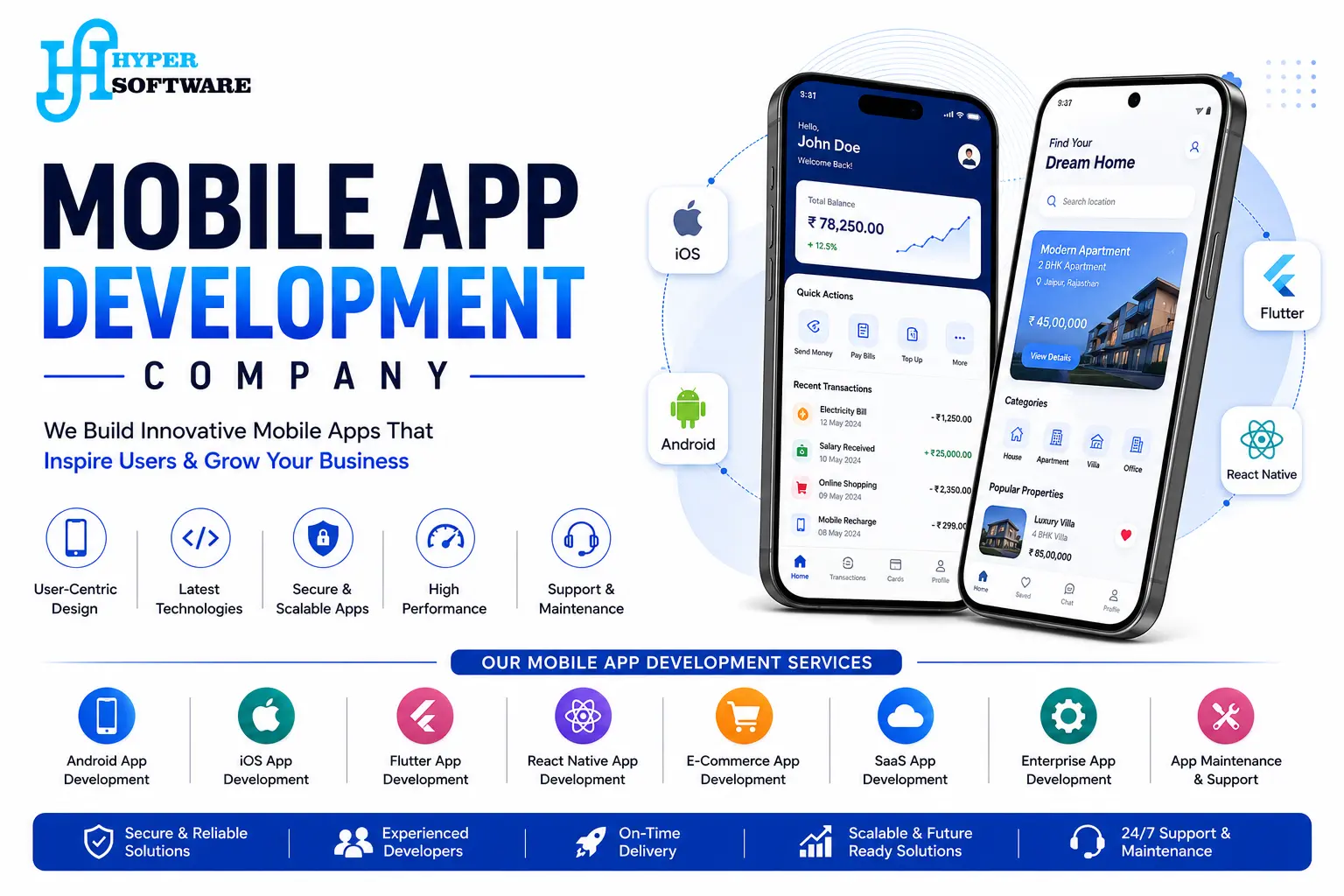
Mobile app development is the process of designing, building, testing, and launching software for smartphones and tablets, covering everything from the first wireframe to the app going live on the App Store and Google Play. If you're reading this, you're probably trying to answer one of two questions: what will it cost, or who should build it. This guide answers both, in plain language, with real numbers.
Hyper Software has been building websites, software, and mobile apps for clients around the world since 2020, out of our team in Jaipur, India. We're not going to give you a vague "it depends" and ask you to fill out a form before you get a real answer. Here's the actual breakdown.
Mobile app development means creating a software application that runs on iOS, Android, or both. It includes market research, UI/UX design, front-end and back-end coding, third- party integrations (payments, maps, notifications), quality testing, and publishing the app to the app stores.
Here's a more useful breakdown by complexity:
| App Type | Example | Estimated Cost | Typical Timeline |
|---|---|---|---|
| Basic App | Simple task management apps, loyalty programs, appointment booking, calculators, or static content applications with essential features. | $10,000 – $25,000 | 6–10 Weeks |
| Moderate App | eCommerce applications with product catalogs, shopping carts, secure payment gateways, user accounts, and order management features. | $25,000 – $80,000 | 3–5 Months |
| Complex App | On-demand marketplace platforms with real-time GPS tracking, live chat, online payments, push notifications, and advanced user interactions. | $80,000 – $180,000 | 5–8 Months |
| Enterprise App | Large-scale business applications with AI-powered features, CRM/ERP integration, multi-role user management, enterprise security, compliance requirements, analytics dashboards, and workflow automation. | $150,000 – $250,000+ | 8–12 Months |
There are three common approaches:
Native apps — built specifically for one platform (Swift for iOS, Kotlin forAndroid). Fastest performance, full access to device hardware, but you need two separate codebases if you want both platforms.
Cross-platform apps — built once using frameworks like Flutter or React Native and deployed to both iOS and Android from a single codebase. This covers most business needs today and cuts cost significantly.
Progressive Web Apps (PWAs) — websites that behave like apps. Users can install them from a browser without going through an app store. Good for lightweight use cases where App Store approval isn't worth the overhead.
For most startups and small-to-mid businesses, cross-platform development is the practical starting point. It's rare that a business truly needs the last 10% of native-only performance, and Flutter and React Native have matured enough that the trade-off barely shows up in everyday use.
Get Free Consultation Within Minutes
Let's get straight to the number everyone actually wants. Mobile app development cost in 2026 typically falls between $10,000 and $250,000+, depending on complexity, platform, features, and where your development team is based. A rough industry average for a serious first version sits around $50,000 to $100,000.
Platform choice. Building native apps for both iOS and Android roughly doubles design and development effort compared to one cross-platform codebase.
Design depth. A polished UI/UX with custom animations and a proper design system usually takes up 15–25% of total budget. Skimping here is a common reason apps lose users in the first 90 days.
Integrations. Payment gateways, live location tracking, chat, and AI features each add their own development hours on top of the base app.
Team location. Rates vary a lot by region. This is exactly why outsourcing part or all of development to an experienced team in India, like Hyper Software, can cut costs by 30–60% without cutting quality, as long as the team has a proven delivery process.
Maintenance. Don't forget this one. Budget 15–20% of your build cost every year after launch for bug fixes, OS updates, and server costs. An app that isn't maintained starts breaking within a year as Apple and Google roll out new OS versions.
This is the decision most clients get stuck on, so here's a straight answer.
Choose Native (Swift/Kotlin) If:
You're building something performance-heavy — Like a game or an app with complex animations or AR/VR.
You need deep access to device hardware — Advanced camera controls, biometric security tied to the secure enclave, or other device-specific capabilities.
You're only targeting one platform anyway — Native development is a strong choice when your application is designed specifically for either iOS app development or Android.
Choose Cross-Platform (Flutter or React Native) If:
You want to launch on both iOS and Android without doubling your budget — Cross-platform development allows you to build for both platforms using a shared codebase.
You're validating a business idea and need to move fast — Flutter or React Native can reduce development time and help you launch faster.
Your app is a standard business, eCommerce, service, or content app — This covers the vast majority of mobile application projects.
| Factor | Native App Development | Cross-Platform App Development |
|---|---|---|
| Codebase Required | Separate codebases for iOS and Android, resulting in two independent development projects. | A single shared codebase is used to build applications for both iOS and Android platforms. |
| Development Cost | Higher overall development and maintenance costs due to separate development efforts for each platform. | Typically 30–50% more cost-effective because one codebase serves multiple platforms. |
| Performance | Delivers the highest possible performance, making it ideal for graphics-intensive and hardware-dependent applications. | Provides performance that is very close to native for most business, eCommerce, and service-based applications. |
| Time to Launch | Longer development timeline since iOS and Android apps are built and maintained separately. | Faster development and deployment because updates are implemented from a single shared codebase. |
| Best Suited For | Mobile games, AR/VR applications, advanced camera features, hardware-intensive apps, and projects requiring maximum performance. | Business applications, eCommerce platforms, service apps, booking systems, marketplaces, CRM solutions, and most commercial mobile applications. |
At Hyper Software, we build with Flutter and React Native for the majority of client projects, and switch to native development when a client's use case genuinely needs it. We'll tell you honestly which one fits your project. We don't push the more expensive option just to inflate the invoice.
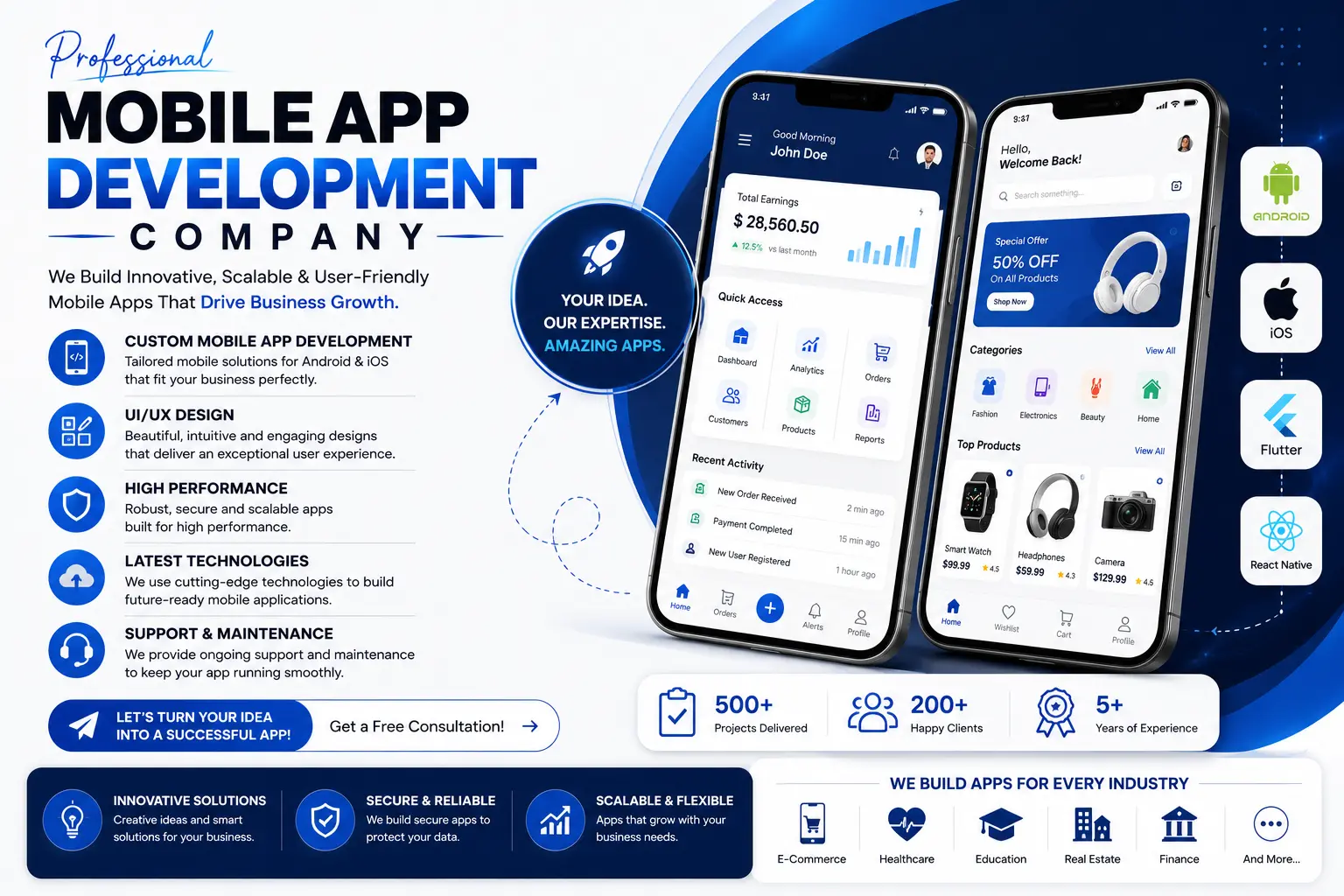
Every app we build moves through the same seven stages. Skipping any one of them is how projects go over budget.
1. Discovery and requirement gathering. We sit down with you (over a call or in person) to understand your business goal, your users, and what problem the app needs to solve. This stage usually takes 1–2 weeks and it's non-negotiable. Skipping discovery to save time almost always costs more later, in rework.
2. Planning and technical scoping. We define the feature list, choose the tech stack, and map out a realistic timeline and budget. You get a clear scope document before any design work starts.
3. UI/UX design. Wireframes first, then interactive prototypes, then final visual design. You review and approve designs before a single line of code gets written. Never accept a quote from a company that skips this step.
4. Development. Front-end and back-end work happen in parallel. Front-end covers what users see and touch. Back-end handles the server, database, and business logic. Any third-party integrations (payments, maps, chat) get built and tested during this stage.
5. Quality assurance and testing. We test across real devices and OS versions, not just simulators. This stage typically takes 15–20% of total development time and catches the bugs that would otherwise surface after launch, in front of your users.
6. Deployment and launch. We prepare app store listings, screenshots, and descriptions, then submit to Apple App Store and Google Play. Apple's review can take several days; Google Play Console is usually faster.
7. Post-launch support. We monitor crash reports and performance, fix issues quickly, and help you plan the next round of feature updates.
Should you build the app yourself using no-code tools, hire freelancers, or bring in a full agency? Here's an honest comparison.
| Approach | Best For | Typical Cost | Potential Challenges |
|---|---|---|---|
| No-Code / DIY | Simple MVPs, personal projects, prototypes, and basic business apps with minimal functionality. | $0 – $5,000 | Limited scalability, restricted customization, difficulty adding advanced features later, and ongoing maintenance is your responsibility. |
| Freelancer(s) | Small to medium-sized projects with clearly defined requirements and flexible timelines. | $10,000 – $40,000 | Availability may be inconsistent, there is no backup if the freelancer becomes unavailable, and code quality can vary depending on experience. |
| Mobile App Development Company | Startups, growing businesses, SMEs, and enterprises that require a reliable, secure, and scalable mobile application. | $10,000 – $250,000+ | Higher initial investment, but you benefit from a dedicated development team, professional project management, quality assurance, long-term maintenance, and post-launch support.
|
If your app is genuinely simple and you're just testing an idea, a no-code tool can work for a few weeks. But the moment you need real backend logic, payments, or the app becoming a core part of your business, doing it alone usually costs more in the long run, once you count the time spent fixing what wasn't built right the first time. That's the pattern we see most often when clients come to us after a failed first attempt elsewhere.
A retail business owner came to us with a simple ask: "I want my customers to order from their phones instead of calling the shop." He'd already tried a no-code app builder himself, but it couldn't handle real-time inventory updates or online payments, and customers kept complaining about crashes.
We started with a two-week discovery phase to map his actual order flow, then built a cross-platform app using Flutter, connected to a proper backend with real-time inventory syncand a payment gateway. We launched an MVP in under 10 weeks, covering ordering, payment, and order tracking. Within the first three months, he reported a noticeable jump in repeat orders, since customers no longer had to call in during busy hours. We're still maintaining the app for him today, rolling out feature updates based on customer feedback.
That's the difference between an app that technically exists and one that actually runs your business.
Skipping market research. Building for an audience you haven't actually validated is the single most expensive mistake, because it means rebuilding core features later.
Choosing native when cross-platform would do the job. Unless you have a specific performance need, building two separate native apps just doubles your cost.
Accepting a quote without wireframes. If a company prices your project before producing wireframes, they're guessing, not estimating. Underfunding design. A poorly designed app can fail even with strong backend functionality.
Ignoring post-launch maintenance. Apps that aren't updated lose compatibility as Apple and Google push OS updates, and eventually stop working properly.
Adding too many features at launch. Feature bloat delays your launch and confuses users. Start with a focused MVP and expand based on real feedback.
Mobile app development is the process of designing, coding, testing, and launching an application for smartphones and tablets, covering both the front-end interface and the back-end systems that power it.
Costs typically range from $10,000 for a basic app to $250,000 or more for a complex, enterprise-grade platform. Most business apps fall between $25,000 and $100,000.
Simple apps take 6–10 weeks. Moderate complexity apps take 3–5 months. Complex or enterprise apps can take 8–12 months.
Native apps are built separately for iOS and Android using platform-specific languages, offering the best performance. Cross-platform apps use one codebase for both platforms, at a lower cost and faster timeline.
Both work well for most business apps. Flutter offers strong performance and one codebase for iOS, Android, and web. React Native suits teams already familiar with JavaScript. The right choice depends on your team and long- term plans.
If your app needs user accounts, real-time data, payments, or content that updates without an app update, yes, you need a backend server and database.
Budget 15–20% of your original development cost every year for maintenance, covering OS updates, bug fixes, server costs, and small feature improvements.
Yes. We handle UI/UX design, front-end development, backend development, API integrations, testing, and app store deployment as one complete service.
We need your target platforms, core features, any third-party integrations you want (payments, maps, chat), and your target launch timeline. A short discovery call is usually enough to give you a real estimate.
Yes, we're happy to sign a non-disclosure agreement before any detailed discussion of your project.
AI is built into the app, not bolted on. Predictive recommendations, in-app assistants, and on-device AI models are becoming standard rather than a premium add-on.
Cross-platform is now the default, not the compromise. Flutter and React Native cover the vast majority of business use cases at a fraction of native cost.
Super apps and mini-app ecosystems are growing, combining payments, messaging, and commerce inside one platform.
Privacy-first, on-device processing is becoming a buyer requirement, not just a nice-to-have, especially for healthcare and finance apps.
AI-assisted coding tools are speeding up development timelines, which is good news for your budget, as long as your development partner still runs proper human QA on top of it.
Hyper Software builds mobile apps for clients across India and internationally, including the US, UK, Canada, Australia, and the Middle East. Whether you're a local Jaipur business or a startup based overseas, we work across time zones and keep communication simple, with regular updates and a single point of contact throughout your project.
Founded in 2020, with a growing portfolio of websites, software, and mobile apps delivered for clients globally.
Full-service team: UI/UX design, Flutter app development and React Native development, native iOS/Android when needed, backend, and QA, all in-house.
Transparent, phase-by-phase pricing. No hidden costs after the contract is signed.
Post-launch support and maintenance plans, so your app doesn't become outdated within a year.
Direct communication with the people actually building your app, not layers of account managers.
Ready to talk about your app idea? Call us at +91 9079282750 or visit www.hypersoftware.in for a free consultation.
Most business apps in 2026 cost between $25,000 and $100,000, depending on features and complexity. Simple apps can start around $10,000, while enterprise-grade platforms can exceed $250,000.
A simple app takes 6–10 weeks. A moderately complex app takes 3–5 months. Enterprise apps with heavy integrations can take 8–12 months.
Both are strong choices for cross-platform development. Flutter has gained more market share recently and offers strong performance across iOS, Android, and web from one codebase. React Native remains a solid option, especially for teams already comfortable with JavaScript.
Not usually. Cross-platform frameworks like Flutter and React Native let you build one codebase that runs on both, saving 30–50% compared to building two native apps.
Yes, for very simple apps, using no-code platforms. But once you need real backend logic, payments, or scalability, you'll need a professional development team.
Have questions or need expert guidance? Our team is ready to help you with the right technology solutions for your business.