Hyper Software ne hamare business ko online ek nayi pehchan di. Website professional, fast aur SEO optimized hai. Website Design & Development ke liye best company.

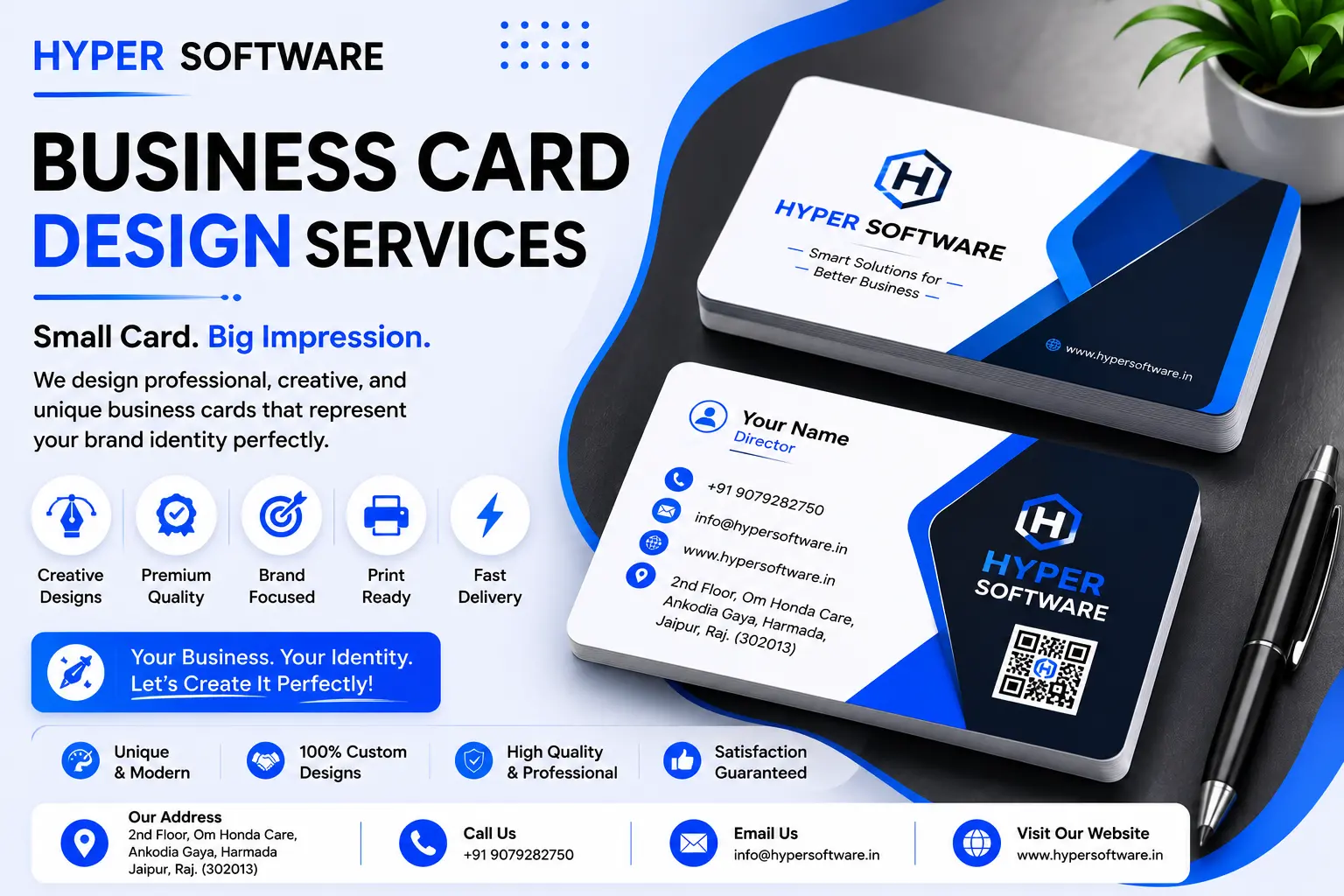
Your business card has about ten seconds to do its job. That's roughly how long most people look at a card before it goes in a wallet, a drawer, or the bin. Business card design is the process of turning your name, your role, and your brand into a small printed card that earns those ten seconds — and gets someone to actually call you back.
At Hyper Software, we design business cards for founders, freelancers, and companies who want their card to look like it belongs to a business people can trust. This guide covers everything you need before you order a design: sizes, costs, what a good card must include, current trends, and the mistakes that quietly kill most cards before they even get printed.
Business card design is the layout, typography, color, and information hierarchy applied to a small printed card — usually 3.5 x 2 inches — that represents a person or a business. It's not just "put your logo on a rectangle." A good design decides what to leave out as much as what to put in.
You'd think business cards would have died by now. Everyone has a phone. Everyone's on LinkedIn. But cards are still handed out at every trade show, client meeting, and networking event we've worked with. Here's why: a phone tap disappears into a contact list within minutes. A card sits on a desk. It gets picked up again. It's a small, physical reminder that your business exists outside a screen, and that still counts for something in a meeting room.
Get Free Consultation Within Minutes
We handle business card design as a standalone service or as part of a full branding package. Here's what's included:
We serve clients across India and internationally. If you're outside India, we work over email and video call, and everything ships as a digital file you can print locally.
Hyper Software ne hamare business ko online ek nayi pehchan di. Website professional, fast aur SEO optimized hai. Website Design & Development ke liye best company.
Clients often ask what actually happens after they hand over a brief. Here's our real process, not a marketing version of it:
Getting the size wrong is one of the most common (and most avoidable) design mistakes. Here's how it breaks down by region:
| RegionSize (inches)Size (mm) | ||
| India | 3.5" x 2" | 89mm x 51mm |
| United States / Canada | 3.5" x 2" | 89mm x 51mm |
| UK / Europe | 3.35" x 2.17" | 85mm x 55mm |
| Japan | 3.58" x 2.17" | 91mm x 55mm |
| Australia | 3.54" x 2.17" | 90mm x 55mm |
| China | 3.54" x 2.13" | 90mm x 54mm |
Bleed and safe zone: Always design with at least 3mm of bleed on every side, so background colors run to the edge cleanly after trimming. Keep all text and logos at least 3– 5mm inside the trim line (the "safe zone") so nothing gets cut off if the trim shifts slightly during printing.
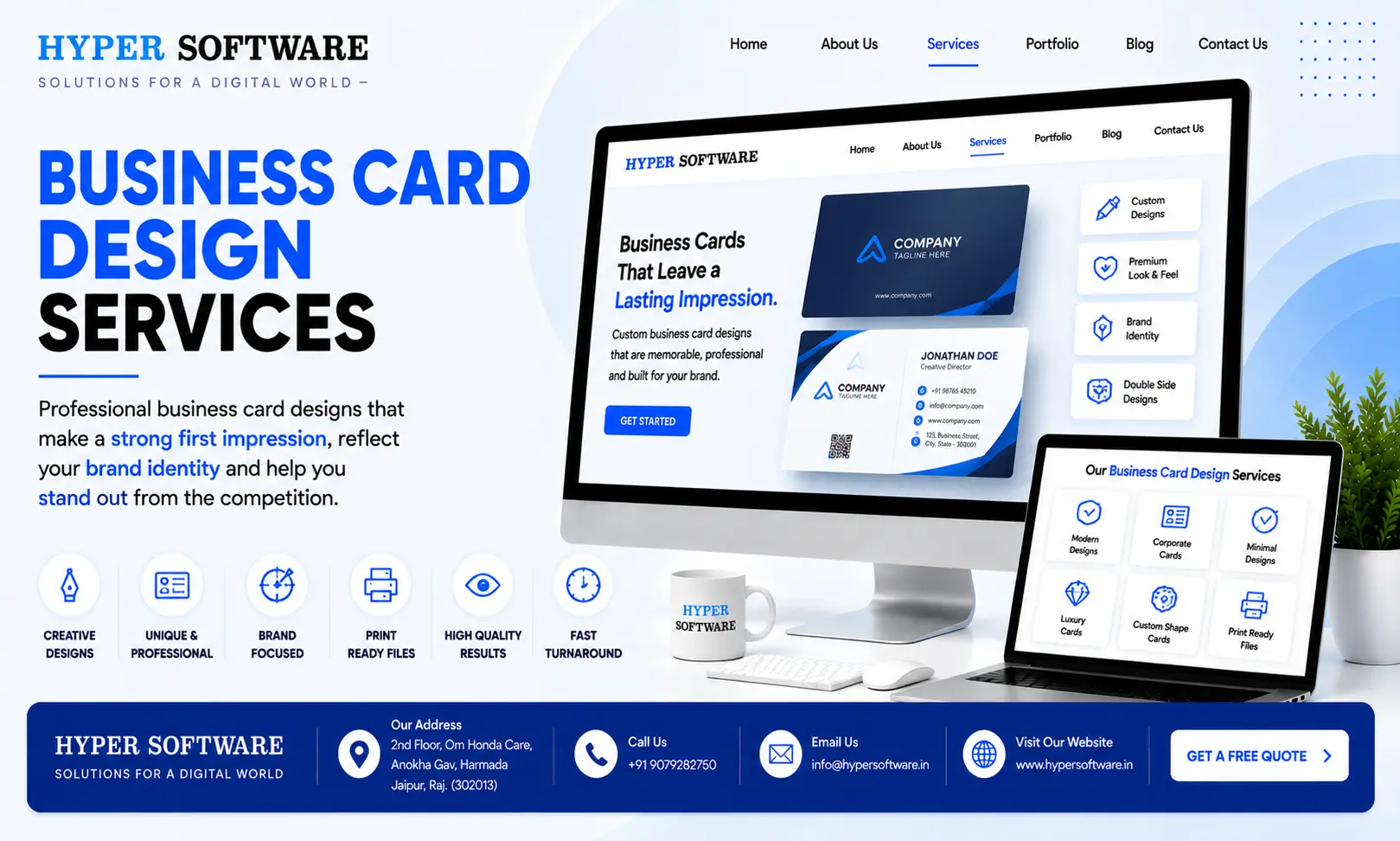
More is not better here. A card that tries to say everything ends up saying nothing clearly. Stick to five core elements:
Everything else — social handles, taglines, a second phone number — is optional, and should only go on the card if it's actually used for business, not just because there was empty space to fill.
A few shifts worth knowing before you brief a designer:
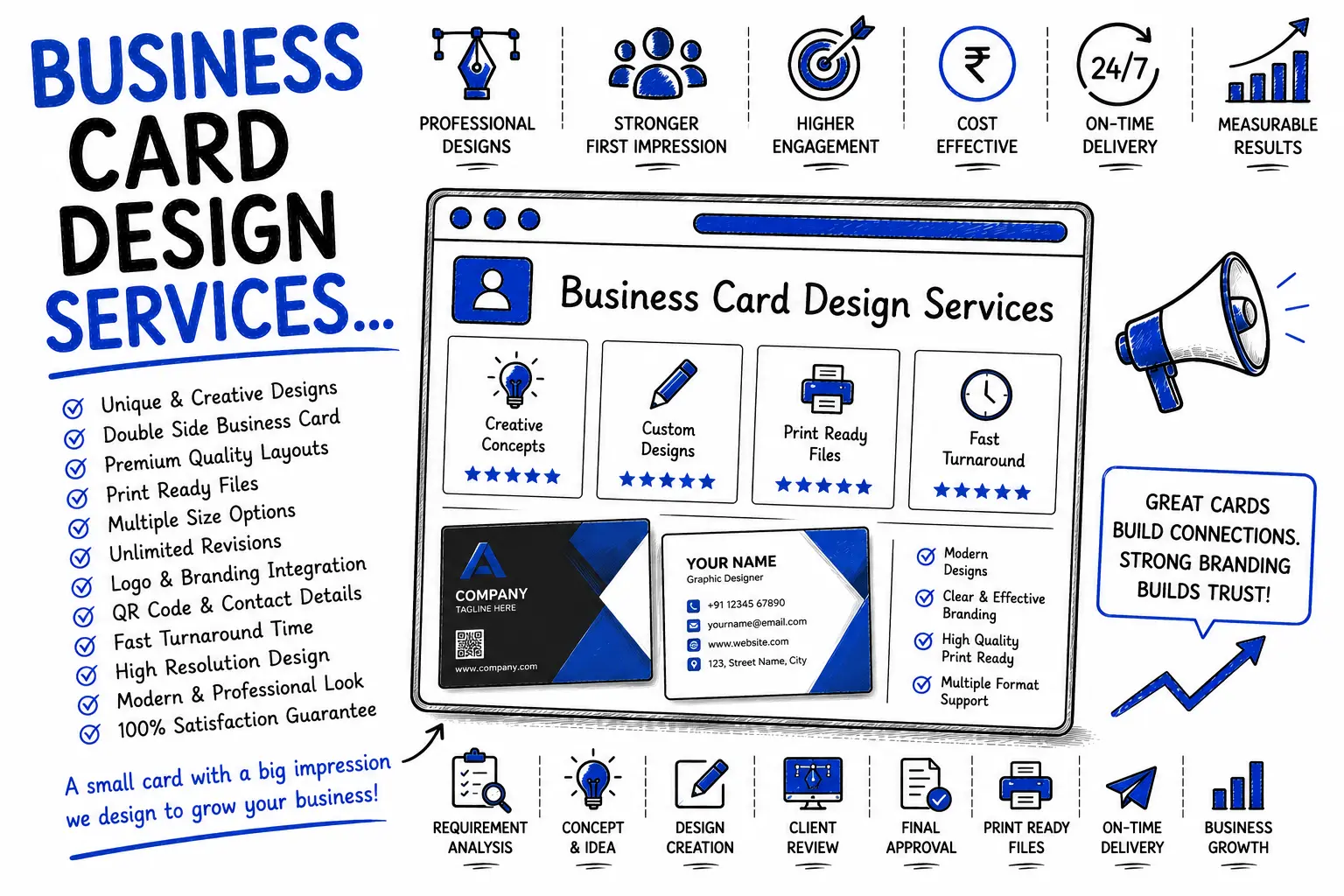
This is the question almost every client asks before reaching out. Here's an honest comparison:
| FactorDIY (Canva/Templates)Freelance DesignerDesign Agency | |||
| Cost | Free to ~₹500 | ₹500–₹3,000 | ₹5,000–₹25,000+ (often bundled with full branding) |
| Turnaround | Same day | 2–5 days | 1–2 weeks |
| Uniqueness | Low (template-based) | Medium to high | High |
| Print-file accuracy | Often needs fixing before print | Usually correct | Correct, with proofing included |
| Best for | Quick, low-stakes needs | Most small businesses and freelancers | Businesses building a full brand identity design |
When DIY makes sense: you need a card today, your budget is close to zero, and the card is a placeholder while you plan something better later.
When hiring a professional makes sense: the card is a client-facing tool that needs to earn trust in a single glance — which, for most small businesses, is most of the time.
What can go wrong doing it alone: wrong color mode (RGB instead of CMYK) causing dull prints, missing bleed causing white edges after trimming, mismatched fonts that don't match your actual brand, and layouts that look fine on screen but crowd up once printed at actual size.
We see the same handful of mistakes across almost every "fix this card" request that comes our way:
A print-ready PDF in CMYK color mode at 300 DPI, with 3mm bleed and fonts converted to outlines, is the standard format accepted by almost all printers.
Yes, when it links somewhere specific and useful, like a portfolio, booking page, or product page. A generic QR code linking to just a homepage rarely adds real value.
They're the same thing. "Visiting card" is the more common term in India, while "business card" is used more widely internationally.
It depends on the industry. Real estate agents and insurance advisors often include a photo since it builds recognition. Lawyers, consultants, and corporate roles usually skip it in favor of a cleaner look.
A freelance designer or small studio typically delivers a design in 2 to 5 days, including one or two revision rounds. Agencies working on a full brand package can take one to two weeks.
Bleed is the extra area beyond the card's trim line where background color or images extend, so there are no white edges after the card is cut. A standard bleed is 3mm on all sides.
Yes, NFC chips can be embedded into card stock so a smartphone tap opens a digital profile automatically. This is more expensive than a QR code but removes the scanning step entirely.
Simple, legible fonts at 7pt or larger work best. Sans-serif fonts like Helvetica or similar clean typefaces read well at small sizes, especially for phone numbers and email addresses.
It helps, but it's not required. Many designers, including our team, can design a simple wordmark or monogram as part of the card project if you don't have a logo yet.
freelancer usually costs less and works one-on-one, which suits most small business needs. An agency costs more but typically bundles the card into a full branding package with a logo, letterhead, and brand guidelines.
A freelance interior designer came to us with a problem that wasn't really about the business card at all. She'd been using a template card from an online printer, and while it looked fine, she noticed that after networking events, people rarely followed up. Her Instagram portfolio, on the other hand, was getting strong engagement. We looked at both together. The card used a generic serif font and a stock logo icon that had nothing to do with her actual style, which leaned modern and warm-toned. It didn't match what people saw when they later checked out her work online. We redesigned the card around her actual brand: a custom monogram based on her logo, a warm neutral color palette pulled from her portfolio photography, and a QR code linking
directly to her Instagram feed instead of a generic website homepage. We kept the information to four lines: name, "Interior Designer," phone number, and the QR code. Within the first month of handing out the new cards at two local events, she told us she'd had three people mention scanning the code and following her account the same day they met her. That's not a guarantee every card produces those numbers, but it shows what happens when the design actually reflects the brand behind it, instead of sitting apart from it.
Hyper Software was founded in 2020 in Jaipur, Rajasthan, and we've grown from a small web development team into a full digital transformation partner for businesses in India and abroad. Business card design sits alongside our website design, graphic design services, custom software, mobile app, CRM/ERP, UI/UX, and digital marketing services, which means we're used to thinking about your brand as a whole system, not a one-off design task.
What that means practically for a card project:
Business card design is the process of creating the layout, typography, colors, and print-ready file for a small card (usually 3.5" x 2") that represents a person or business, typically including a name, title, company, and contact details.
The standard size is 3.5 x 2 inches (89mm x 51mm) in India, the US, and Canada. The UK and Europe use 85mm x 55mm, and Japan uses a slightly longer 91mm x 55mm format.
Design-only cost typically ranges from ₹500 to ₹3,000 for a freelance designer in India, or ₹5,000+ if bundled into a full branding package with an agency. Printing is a separate cost based on quantity and material.
A business card should include your name, job title, company name and logo, one primary contact method, and a website or QR code. Avoid cramming in more than five core pieces of information.
Yes, tools like Canva offer free business card templates. This works for quick, low-stakes needs, but a professionally designed card usually looks more distinct and represents your brand more accurately.
Have questions or need expert guidance? Our team is ready to help you with the right technology solutions for your business.