
Hyper Software ne hamare business ko online ek nayi pehchan di. Website professional, fast aur SEO optimized hai. Website Design & Development ke liye best company.

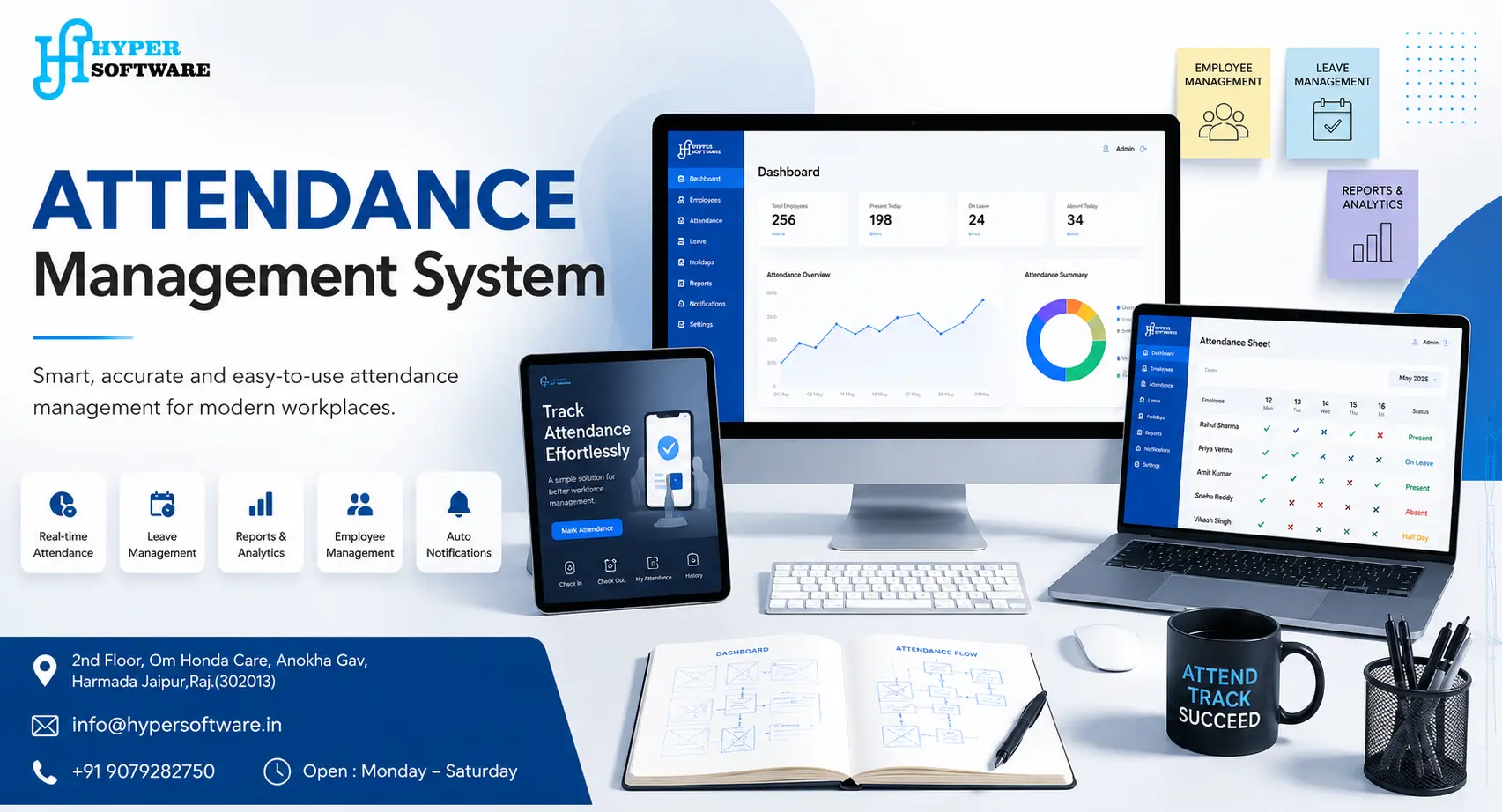
Chasing down late timesheets. Fixing payroll after someone forgot to punch out. Explaining to a factory owner why three employees clocked in for a fourth who never showed up. If any of that sounds familiar, you don't need another spreadsheet — you need an attendance management system that actually matches how your business runs.
An attendance management system is software that records when your employees start and stop work, tracks their leave and overtime, and sends clean, accurate hours straight into payroll. Done right, it removes the manual chasing, the buddy punching, and the end-of-month scramble to reconcile hours before salaries go out.
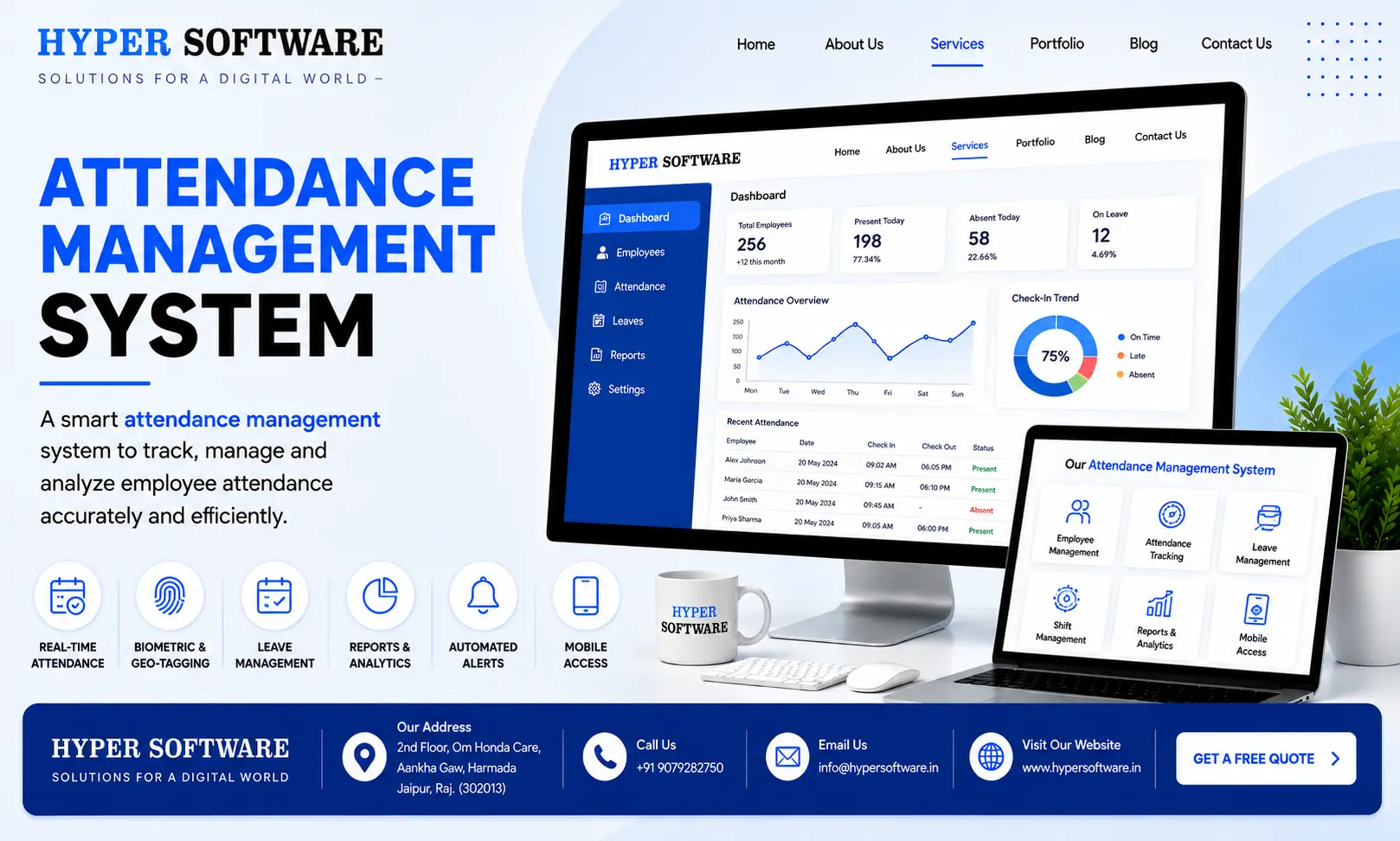
At Hyper Software, we don't sell you a rigid, one-size-fits-all subscription. We build attendance management systems around your actual shift patterns, leave policy, branch structure, and payroll software — whether that's for a single office in Jaipur or a 12-branch retail chain spread across three states.
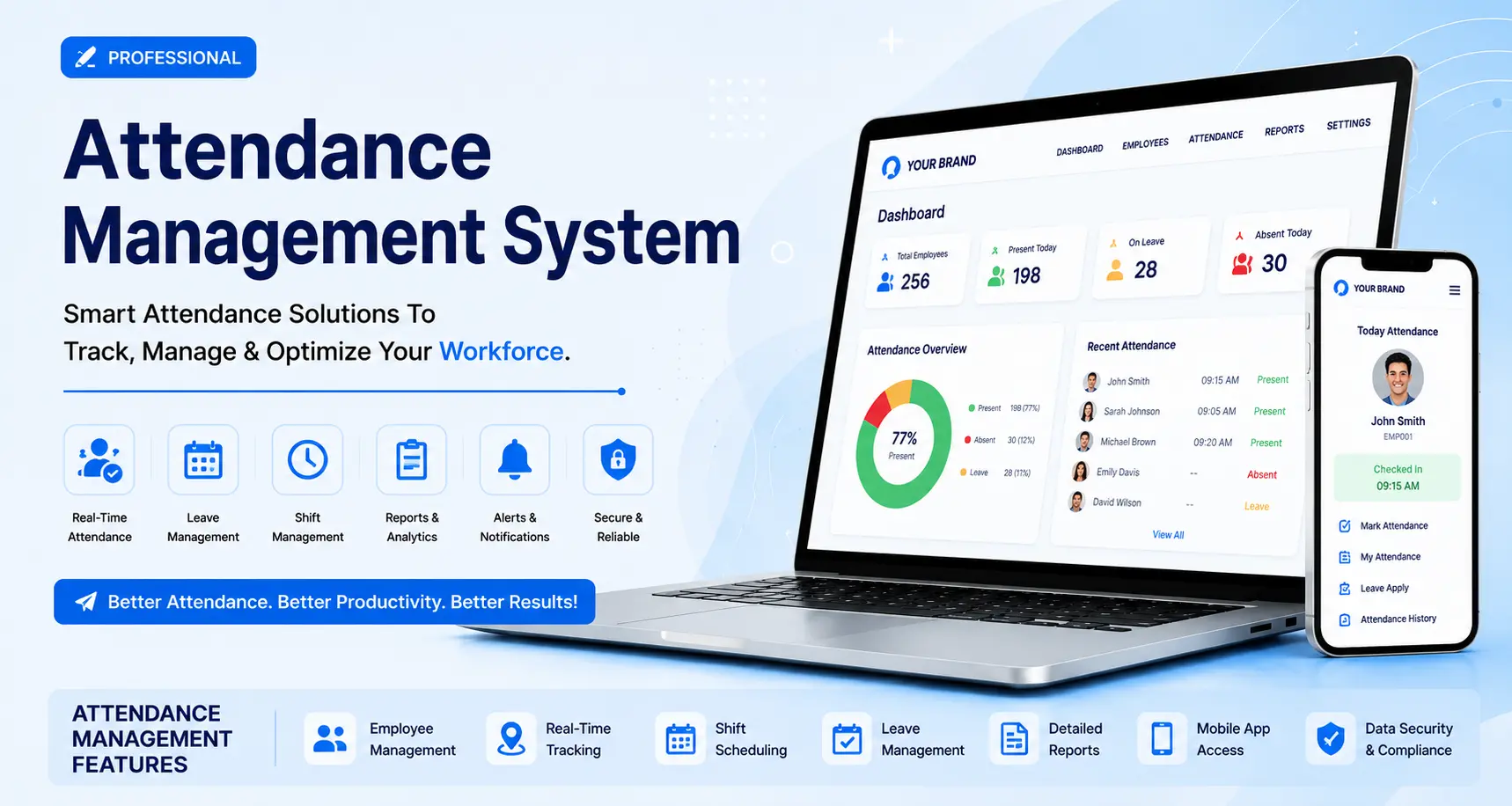
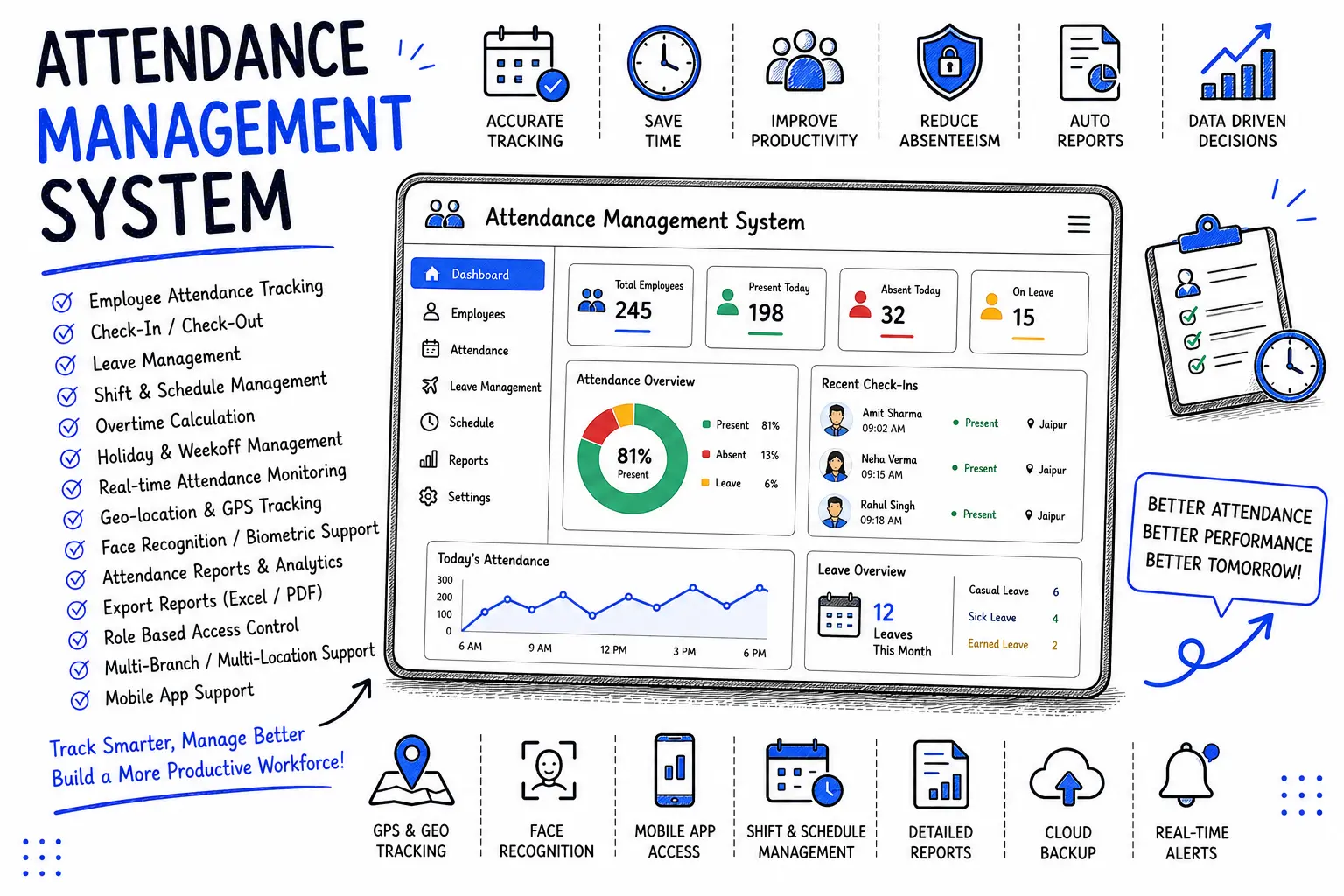
An attendance management system is a software platform that automates the tracking of employee presence, working hours, breaks, leave, and overtime. Instead of a paper register or an Excel sheet someone forgets to update, employees check in through a biometric scanner, a mobile app, an RFID card, or a web portal — and the system logs the exact time, calculates hours worked, and flags anything unusual.
The data doesn't stop at "present" or "absent." A properly built system tracks late arrivals, early exits, shift swaps, overtime thresholds, and leave balances, then pushes all of it into payroll so salaries are calculated on real numbers, not guesses.
Get Free Consultation Within Minutes
Manual attendance tracking breaks down the moment you cross about 15–20 employees. Here's where it actually costs you money and time:
A well-built attendance system fixes all five without you having to babysit it.
Hyper Software ne hamare business ko online ek nayi pehchan di. Website professional, fast aur SEO optimized hai. Website Design & Development ke liye best company.

Not every business needs the same check-in method. Here's how the main types break down.
Best for on-site teams — offices, factories, warehouses. Employees clock in with a fingerprint or facial scan, which makes buddy punching close to impossible. Devices in India typically range from around ₹3,000 for a basic fingerprint scanner to ₹25,000+ for enterprise face-recognition terminals, and the software layer on top is what actually turns that raw scan data into usable reports.
Built for field staff, sales teams, and remote or hybrid employees. The employee checks in through a mobile app, and the system captures GPS location, timestamp, and often a selfie for verification. No hardware to install, no device to maintain at every site — just an app.
Common in factories and larger campuses where employees already carry an ID badge. Fast, low-friction, but less secure against card-sharing than biometric.
Lets employees view their own attendance history, apply for leave, and check their balances without going through HR for every small query. Nearly every modern system pairs this with whichever check-in method is used on the ground.
 Ready-Made Software vs a Custom-Built System
This is the decision most businesses actually face, and most articles online skip it entirely because they're written by SaaS companies selling their own subscription.
| Factor | Off-the-Shelf SaaS Tool | Custom-Built System |
| Upfront cost | Low to none | Higher, one-time development cost |
| Long-term cost | Per-user, per-month, forever — scales with headcount | Fixed development cost, only ongoing hosting/maintenance |
| Fit to your leave policy | Generic rules, limited customization | Built exactly around your policy, shifts, and approval chain |
| Integration with existing payroll/ERP | Often limited or needs a paid add-on | Built to talk directly to your existing systems |
| Data ownership |
Vendor's servers, vendor's terms |
You own the code, the database, and the hosting |
| Best for | Fast-moving startups needing something running this week | Established businesses with specific workflows or multiple integrations |
If you're a 10-person startup, a ready-made tool might genuinely be the faster call. If you've got branch-specific shift rules, an existing payroll system, or compliance requirements a generic tool won't bend to, a custom build pays for itself within a year or two of avoided per-user fees.
Pricing depends heavily on scope, so treat any number you see online as a starting range, not a quote.
Basic biometric hardware: roughly ₹3,000–₹25,000 per device depending on fingerprint vs facial recognition and build quality.
SaaS subscriptions: commonly ₹50–₹500 per employee per month depending on features, which adds up fast for a 100+ employee company.
Custom-built system (Hyper Software): priced per project based on features — biometric integration, mobile app, number of admin roles, payroll hooks, and reporting depth. A single-location system with core features costs meaningfully less than a multi-branch build with GPS tracking, payroll sync, and a custom mobile app.
We quote after understanding your actual requirement — number of employees, locations, check-in method, and what it needs to integrate with. No package pricing that half-fits your business.
We follow the same process whether you're a 30-person office or a 500-employee manufacturing group:
1. Requirement mapping. We sit down with your HR and admin team to understand shift patterns, leave policy, branches, and existing software.
2. Architecture & tech selection. Depending on scale, we build in Core PHP, Laravel, or a MERN stack, with a database structure designed for your reporting needs from day one.
3. Check-in method integration. Biometric device APIs, GPS-based mobile app, RFID reader integration, or web check-in — sometimes a mix of two or three depending on your teams.
4. Payroll & HRMS integration. We connect attendance data directly to your payroll process so hours worked translate into salary without manual re-entry.
5. Admin dashboard & reporting. Real-time views for HR, exportable reports, and role-based access so managers only see what's relevant to them.
6. Testing across real conditions. We test check-in flows under actual office Wi-Fi, low-light face recognition, and offline scenarios for field staff before go-live.
7. Deployment & training. We host it, walk your HR team through it, and stay on for support and maintenance after launch.
For India-based businesses, accurate attendance records aren't just an HR convenience — they matter for compliance under the Shops and Establishments Act, the Factories Act, and the Payment of Wages Act, all of which require verifiable working-hour records for wage and overtime calculations. Biometric data, in particular, needs to be stored responsibly: encrypted, access-controlled, and retained only as long as necessary.
For global clients, we build with data protection principles aligned to GDPR where personal or biometric data is involved, and we can architect the system so sensitive data stays on infrastructure that matches your region's requirements.
A Jaipur-based manufacturing client came to us after a payroll dispute where three employees claimed they'd worked a Saturday shift that HR had no record of. Their attendance was still on paper registers, spread across two floor supervisors who didn't always cross-check. We built them a biometric attendance system with a face-recognition terminal at each floor entry, tied directly into their existing payroll software.
Within the first month, their HR manager caught two cases of buddy punching that had likely been happening for months. Payroll disputes dropped to almost zero because every clock-in had a timestamp and a face match nobody could argue with. The floor supervisors, who used to spend an hour each evening reconciling registers, now just glance at a dashboard.
Some businesses try to patch together a free tool plus a spreadsheet plus a biometric device bought off Amazon. It works, briefly — until the free tool hits its user cap, the spreadsheet formula breaks, and nobody remembers how to fix the integration between the device and the sheet. What looks like a saved cost turns into hours of HR time every single week.
Hiring a development partner means the system is built once, correctly, integrated with what you already use, and someone is accountable when something needs fixing. For most businesses past the 20-employee mark, this stops being optional.
It's software that automatically tracks when employees clock in and out, records leave and overtime, and feeds accurate hours into payroll — replacing manual registers or spreadsheets.
Ready-made SaaS tools typically run ₹50–₹500 per employee per month. Biometric hardware ranges from ₹3,000–₹25,000 per device. A custom-built system is priced per project based on features and scale — we quote after understanding your requirement.
It depends on your team. Biometric works best for on-site staff and stops buddy punching almost entirely. A mobile GPS app is better for field staff, sales teams, or remote employees who aren't at a fixed location.
Yes. When custom-built, the attendance system is designed to connect directly with your payroll process, so hours worked calculate salary without manual re-entry.
Timelines depend on scope, but a single-location system with core features typically takes a few weeks, while a multi-branch build with biometric integration, a mobile app, and payroll sync takes longer. We give an exact timeline after the requirement mapping stage.
Yes, a properly built system rolls up attendance from every branch into one central dashboard, with role-based access so branch managers see only their location's data.
A well-built system caches check-ins locally and syncs them once the connection is restored, so you don't lose attendance data during short outages.
It should be encrypted, access- controlled, and retained only as needed. For global clients, we build with data protection principles aligned to GDPR where personal or biometric data is involved.
Yes, most builds include a self-service portal where employees can check their attendance history, apply for leave, and view their leave balance without going through HR for every query.
Attendance software focuses specifically on tracking hours, leave, and shifts. An HRMS is broader, covering recruitment, payroll, performance, and more. Attendance is often a core module inside a larger HRMS.
Accurate, time-stamped attendance records support compliance requirements under the Shops and Establishments Act, Factories Act, and Payment of Wages Act, which require verifiable working-hour data for wage and overtime calculations.
Yes, overtime rules — daily or weekly thresholds — are configured once, and the system flags and calculates overtime hours automatically instead of someone tallying it by hand.
For under 15–20 employees, a ready-made tool is often faster and cheaper to start with. Once you cross that size, or need integrations a generic tool won't support, a custom build usually pays for itself within a year or two.
It shouldn't be. A well-designed system only captures location at the moment of check-in/check-out, not continuous tracking, and this should be communicated clearly to employees as part of company policy.
Yes, we stay on for support and maintenance after go-live, including bug fixes, feature additions, and helping your HR team as their requirements evolve.
Have questions or need expert guidance? Our team is ready to help you with the right technology solutions for your business.