
Hyper Software ne hamare business ko online ek nayi pehchan di. Website professional, fast aur SEO optimized hai. Website Design & Development ke liye best company.

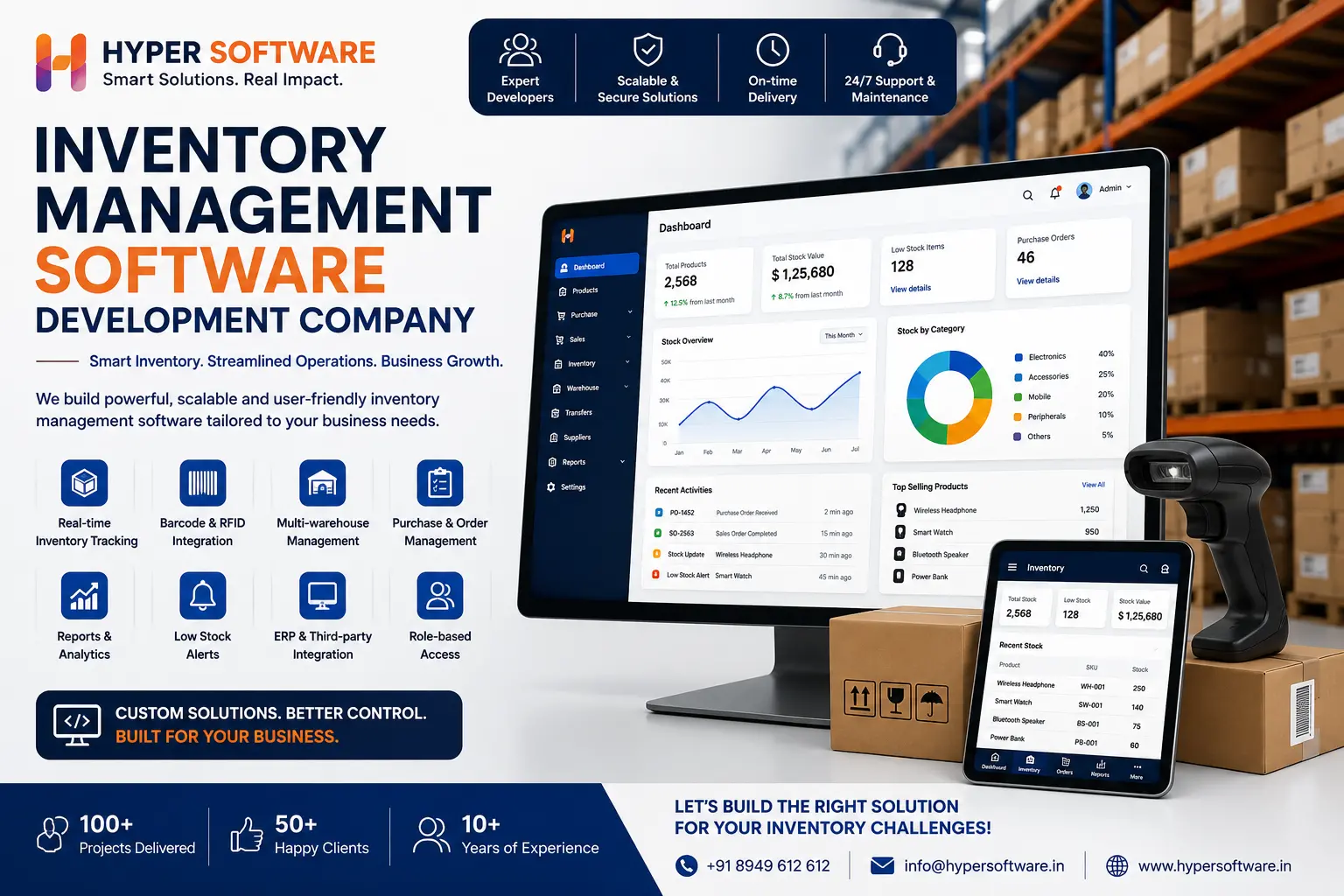
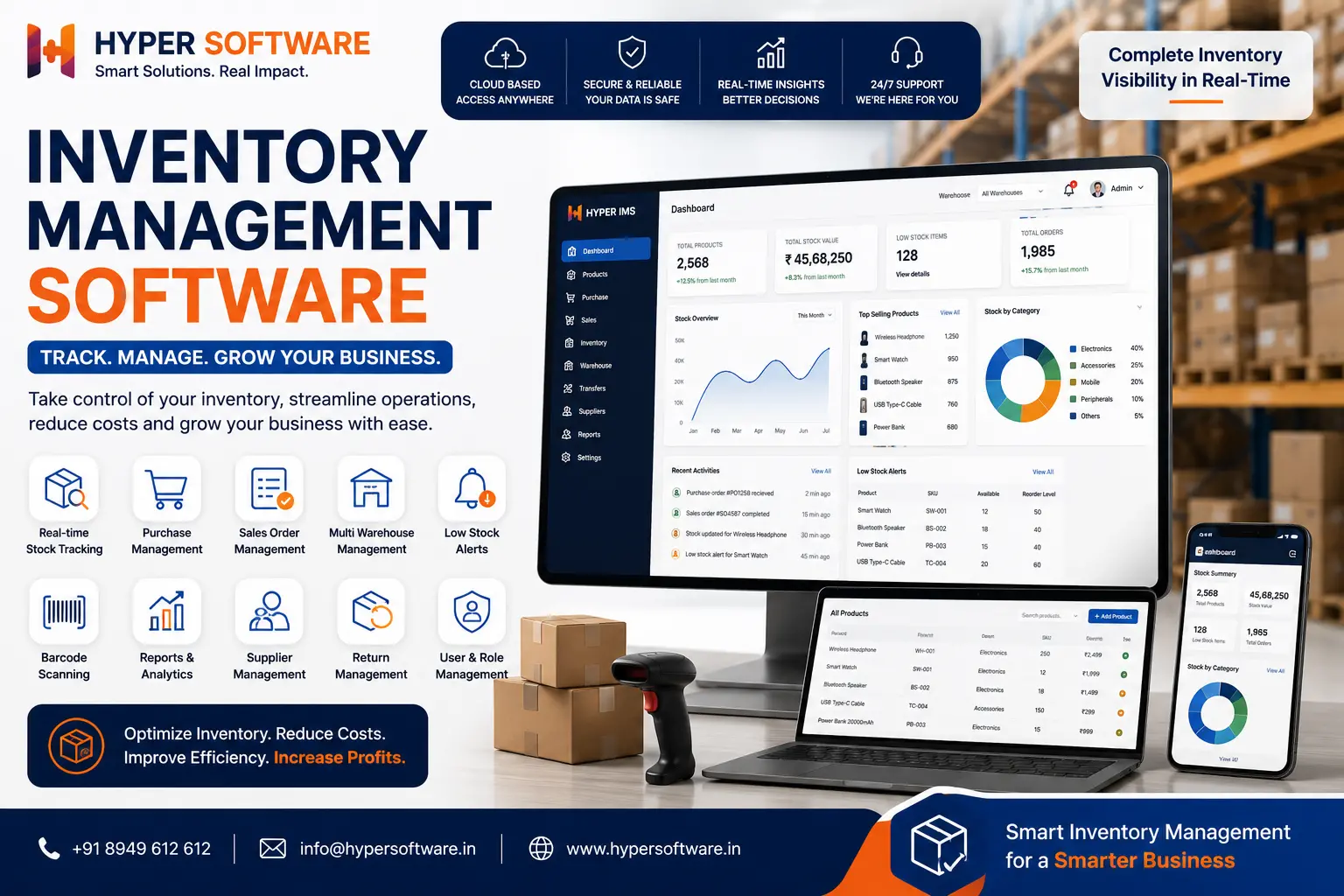
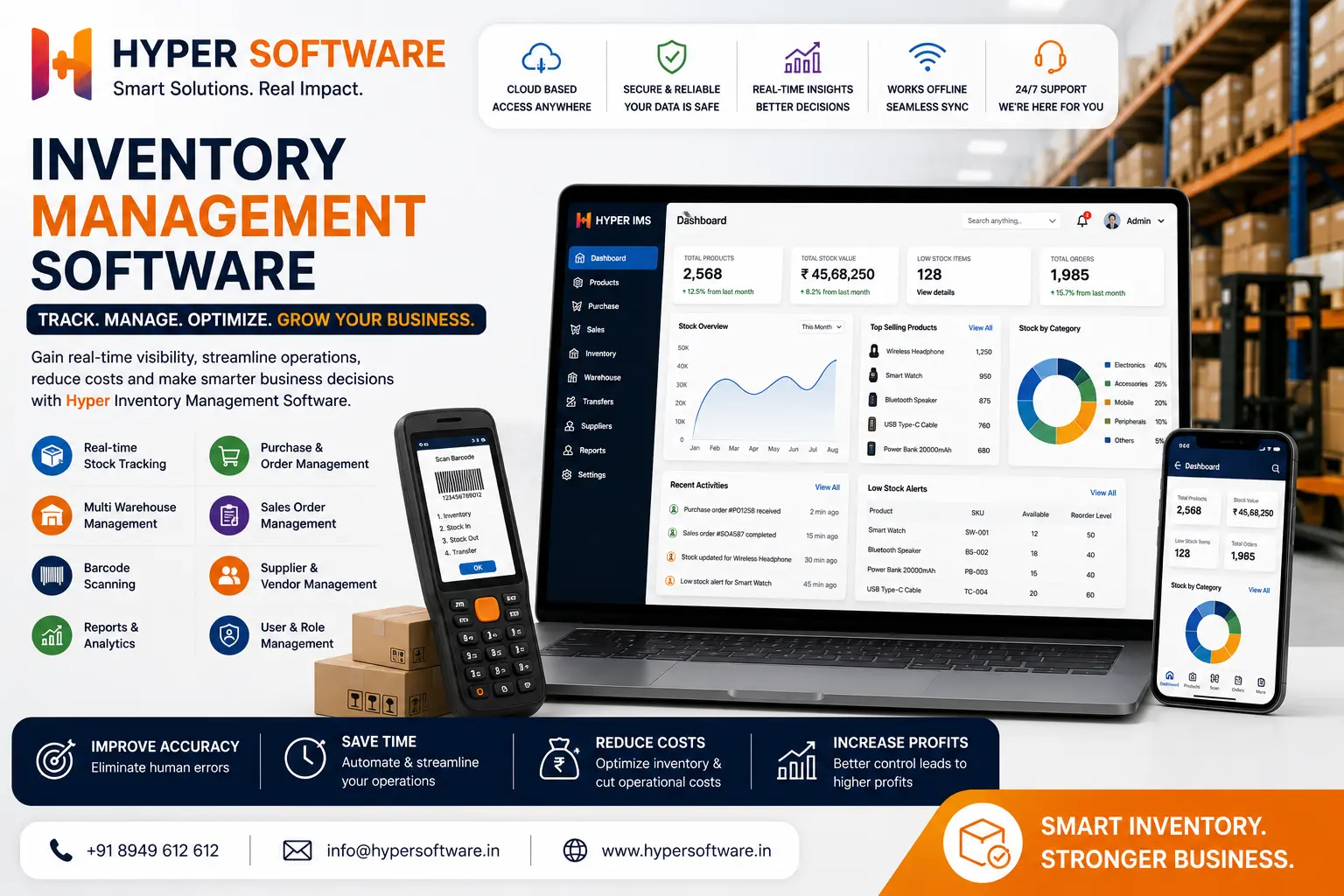
Inventory management software tracks what you have, where it is, and when it needs reordering — automatically, in real time, across every location you operate from. If spreadsheets or a basic off-the-shelf tool are still running your stock, you already know where the cracks show up: a stockout nobody saw coming, two warehouses with two different numbers for the same SKU, or a reorder that goes out three weeks too late.
Hyper Software builds inventory management systems that match how your business actually works, not the other way around. We're an IT solutions company based in Jaipur, and we've built stock, warehouse, and supply chain systems for retailers, manufacturers, and distributors who outgrew their off-the-shelf tools and needed something built around their exact process.
Inventory management software is a system that records every unit of stock you own, tracks it as it moves between suppliers, warehouses, and customers, and updates that record automatically instead of relying on someone typing it into a spreadsheet.
A good system does four things well: it tells you exact stock levels at any moment, it flags when something is about to run out, it ties every movement back to a purchase order or sale, and it gives you a single number your finance, sales, and warehouse teams all trust. When any one of those breaks, the rest of the business feels it fast — usually as lost sales or dead stock sitting in a corner nobody's tracking.
Get Free Consultation Within Minutes
Tools like Zoho Inventory, QuickBooks, or Odoo are genuinely good, and for a single- location business selling a manageable number of SKUs, they'll probably do the job. We tell clients this upfront — there's no reason to build custom software if a $30/month tool solves your problem.
The trouble starts when your business does something these tools weren't built for. A jewelry retailer we worked with needed to track inventory by weight, stone type, and purity, keep consignment stock completely separate from owned stock, and run inter-store transfers through an approval chain. No off-the-shelf platform handled all three at once — they'd have needed three tools stitched together with manual work in between, which defeats the point of automation in the first place.
That's usually the real trigger for going custom: not "off-the-shelf is bad," but "off-the-shelf makes me work around it instead of the other way around."
Every business gets a different mix, but these show up in almost every project:
We don't build all nine into every project on day one. We usually start with the three or four that solve the actual problem, then add the rest as the system earns its keep.
This is one of the first decisions we walk clients through, because it changes both cost and
hardware.
Barcodes are cheap, familiar, and easy to roll out. The catch: every item needs to be scanned one at a time, in a straight line of sight. For a small warehouse or retail counter, that's rarely a problem.
RFID reads dozens of tags at once, without needing a direct line of sight, which is why large warehouses and high-volume operations lean toward it. The tradeoff is upfront cost — tags, readers, and antennas cost more than barcode labels and a handheld scanner.
QR codes sit in between — cheap like barcodes, but they can carry more data and work well for asset tracking where a phone camera is the scanner.
| Factor | Barcode | RFID | QR Code |
|---|---|---|---|
| Setup Cost | Low | Higher (tags + readers) | Low |
| Scan Speed | One item at a time | Multiple items at once | One item at a time |
| Line of Sight Needed | Yes | No | Yes |
| Best For | Small to mid-size operations | High-volume, multi-warehouse environments | Asset tracking and mobile scanning |
If you're running one location and a few hundred SKUs, GS1 barcode standards is usually the right starting point. If you're moving pallets across multiple warehouses daily, RFID pays for itself faster than most people expect.
Hyper Software ne hamare business ko online ek nayi pehchan di. Website professional, fast aur SEO optimized hai. Website Design & Development ke liye best company.

This is the question every client leads with, and it's a fair one. Based on how these projects typically scope out:
| Build Type | Approx. Cost (USD) | Approx. Cost (INR) | Timeline |
|---|---|---|---|
| Basic Stock Tracker (Single Location) | $20,000 – $50,000 | ₹17 lakh – ₹42 lakh | 6–10 weeks |
| Mid-Size System (Barcode + Multi-Location) | $50,000 – $120,000 | ₹42 lakh – ₹1 crore | 3–5 months |
| Enterprise System (RFID + ERP Integration + AI Forecasting) | $120,000 – $250,000+ | ₹1 crore – ₹2 crore+ | 6–9 months |
A few things move this number more than people expect:
These are software development cost ranges only — hardware (scanners, RFID readers) is quoted separately based on warehouse size.
| Feature | Off-the-Shelf | Custom Built |
|---|---|---|
| Upfront Cost | Low ($20–300/month) | Higher one-time investment + maintenance |
| Fits Unique Workflows | Rarely | Built around your exact business processes |
| Ownership | You rent access | You fully own the system |
| Scalability | Limited by the vendor's roadmap | Scales according to your business needs |
| Best For | Simple, single-location inventory or stock management | Complex, multi-location, enterprise, or regulated operations |
Neither one is "better" in the abstract. If your workflow fits a $50/month tool, paying six figures for custom software is a waste of money, and we'll tell you that in the first call. Custom makes sense once you're paying for three tools stitched together, or building spreadsheets to cover what your software can't.
Some businesses try building this in-house, usually with a spreadsheet macro or a low-code tool bolted together by whoever's most comfortable with Excel.
Doing it yourself works for a while if your stock is small and simple. It usually breaks the moment you add a second location, a second person entering data, or a busy season that outpaces manual updates. The real cost isn't the time spent building it — it's the stock discrepancies and lost sales while it's held together with patches.
Hiring a development company costs more upfront, but you get a system built to scale, proper support when something breaks, and someone accountable for it working. For most businesses past the "just me and a spreadsheet" stage, this pays for itself within the first year through fewer stockouts and less time reconciling numbers.
A distribution business in Rajasthan came to us running three warehouses on one shared spreadsheet, updated manually by whoever was nearest a laptop at the time. Stock counts were routinely off by 10–15%, and their team was spending hours each week just reconciling numbers between locations before anyone could trust them.
We built a multi-warehouse inventory system with barcode scanning at each location, automatic reorder alerts, and a single dashboard showing real stock across all three warehouses. The rollout took about 14 weeks, including staff training. Within the first two months, their stock discrepancy rate dropped sharply, and the weekly reconciliation task disappeared entirely — the numbers were just already right.
Yes. Integration with SAP, NetSuite, Tally, or QuickBooks is one of the most common requests, though it's usually priced separately from the core build.
Yes, multi- warehouse sync is one of the most requested features — it gives you one accurate stock number visible from every location.
Real-time tracking, reorder alerts, and basic reporting cover most small business needs before anything more advanced is worth the cost.
Usually not yet. RFID pays off at higher volume and multiple locations; barcode is the more cost-effective starting point for smaller operations.
Yes, when it's synced in real time with your storefronts (Shopify, Amazon, etc.), stock updates the moment an item sells anywhere.
Most businesses migrate their data to the new system in stages, running both in parallel briefly during rollout to avoid disruption.
Many modern systems support phone-camera scanning for QR/barcodes, which cuts hardware cost significantly for smaller teams.
Automated systems typically bring discrepancy rates down sharply compared to manual entry, since every movement is logged at the point it happens rather than re-entered later.
Yes, this is a standard feature for pharma, food, and any regulated goods, flagging near-expiry stock automatically.
With custom development, you own the system outright — unlike a subscription tool where you're renting access and lose everything if you stop paying.
We're a Jaipur-based team that's been building custom software, ERP development integrations, and business automation systems since 2020, for clients across India and globally. We don't sell you a fixed package — we scope the system around your actual stock workflow, tell you honestly when an off-the-shelf tool would do the job cheaper, and stay on for support once you're live, not just until launch.
Call us at +91 9079282750 or visit hypersoftware.in to talk through what your inventory system actually needs.
It's a system that tracks stock levels, locations, and movement in real time, replacing manual spreadsheets or paper counts with automated, always-current records.
Most custom builds range from $20,000 for a basic single-location system to $250,000+ for an enterprise build with RFID and ERP integration. Cost depends mainly on integrations and hardware, not the base software.
Off-the-shelf is better for simple, single-location stock. Custom is better once your workflow, integrations, or scale outgrow what a generic tool supports.
A basic MVP typically takes 6–10 weeks. A full enterprise system with ERP integration and RFID can take 6–9 months.
Barcodes need a direct line of sight and are scanned one at a time. RFID reads multiple tags at once without line of sight, but costs more to set up.
Have questions or need expert guidance? Our team is ready to help you with the right technology solutions for your business.