
Website design se lekar final launch tak pura process bahut smooth raha. Team har update time par deti rahi aur support bhi outstanding mila.

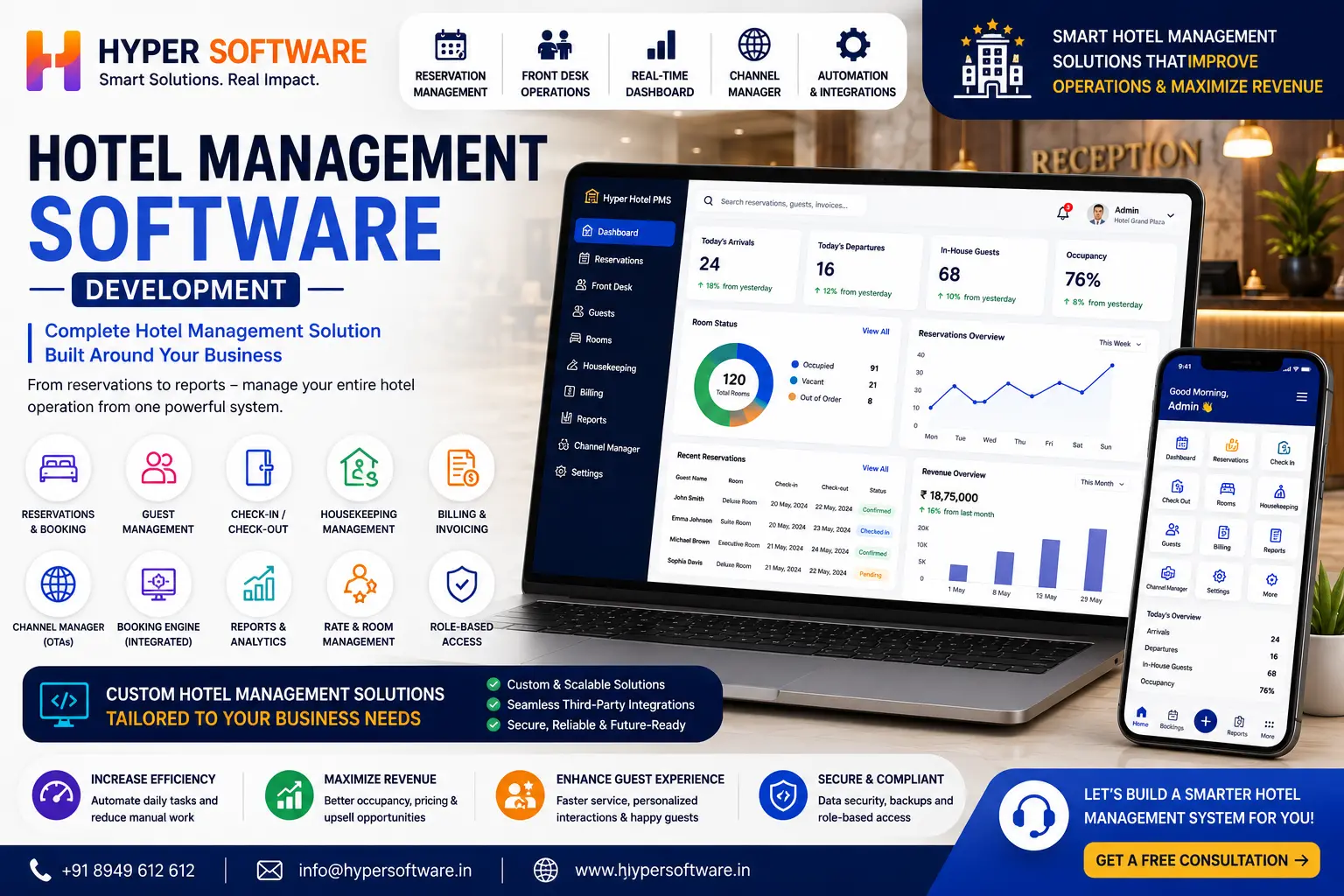
Running a hotel without the right software means double bookings, guests waiting at the front desk, and a spreadsheet that never quite matches the room chart. Hotel management software is a digital system that automates reservations, check-in and check-out, housekeeping, billing software development , and room inventory from one dashboard — and it's the difference between a hotel that runs itself and one that runs its staff ragged.
At Hyper Software, we build custom hotel management systems for independent hotels, resorts, homestays, and multi-property groups who want software built around their actual workflow, not the other way around. This page covers what hotel management software actually does, what it costs to build one, how our development process works, and how to decide between buying an off-the-shelf tool and building your own.
Hotel management software (also called a Hotel Management System, or HMS) is a centralized platform that runs the day-to-day operations of a hotel: reservations, front-desk check-in/check-out, room inventory, housekeeping, billing, and reporting. Most modern systems are cloud-based, so staff can manage the property from a laptop, tablet, or phone instead of being tied to a front-desk PC.
A complete hotel management setup usually includes four connected pieces:
Some hotels also add a Revenue Management System (RMS) to adjust pricing automatically based on demand, and a POS software module if the property runs a restaurant management software or bar.
Get Free Consultation Within Minutes
Off-the-shelf hotel software works fine for a lot of properties. It's quick to set up and there's no development wait. But we hear the same three complaints from hotel owners who come to us after a year or two on a SaaS platform:
That's not a knock on SaaS tools — they're the right call for a lot of properties, especially very small ones just getting started. But once a hotel has predictable volume and a workflow it wants software to match exactly, building a custom system usually pays for itself within two to three years, and you own it outright after that.
Every hotel is different, so we scope modules based on the property, not a fixed template. Here's what typically goes into a custom hotel management system:
Front Desk & Reservation Management
Room availability calendar, one-click check-in/check-out, guest profile history, group bookings, and split billing.
Channel Manager Integration
Two-way sync with Booking.com, Expedia, Airbnb, Agoda, MakeMyTrip, and other OTAs, so rates and inventory update everywhere the moment a room is booked or blocked.
Direct Booking Engine
A booking widget embedded on your hotel's own website, so guests can reserve rooms directly — commission-free — with real-time availability and secure online payment.
Housekeeping & Maintenance
Room status tracking (clean, dirty, inspected, out of order), task assignment for housekeeping staff, and maintenance request logging.
Revenue & Rate Management
Rules-based or dynamic pricing tied to occupancy, season, and demand, so rates adjust without someone manually updating every OTA.
Billing, Invoicing & Accounting
GST-ready invoicing, multiple payment modes, folio management, and export-ready reports for your accountant.
Guest CRM & Loyalty
Guest preference tracking, repeat-stay history, automated pre-arrival and post-stay emails, and loyalty point systems for return guests.
Reporting & Analytics Dashboard
Occupancy rate, ADR (average daily rate), RevPAR, staff performance, and revenue-by-channel reports, viewable from any device.
Multi-Property Management
For hotel chains, a single dashboard to manage rates, inventory, and reporting across every property from one login.
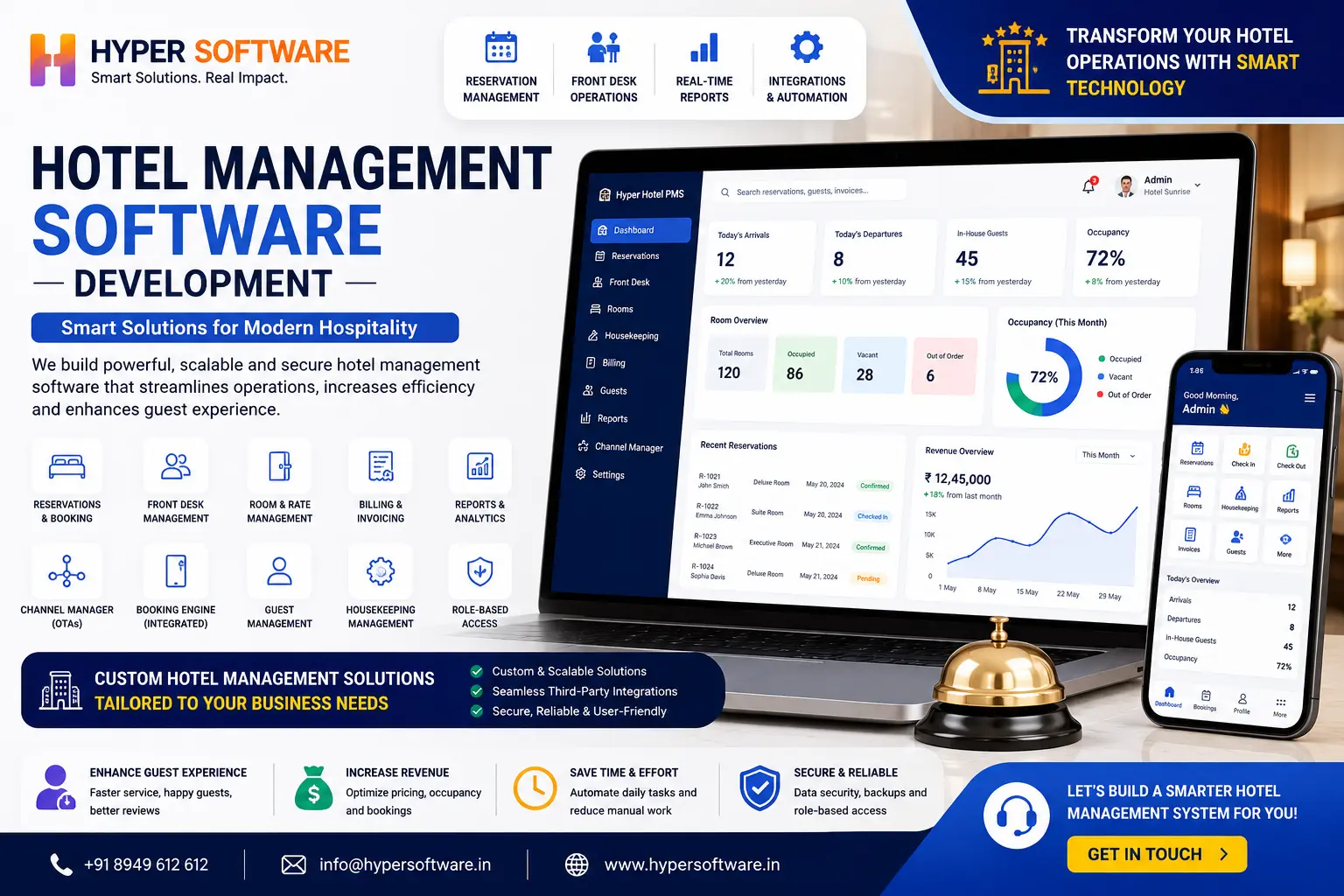
Not every hotel needs the same build. We typically scope one of these:
| Type | Best For | What's Included |
|---|---|---|
| PMS-Only System | Small hotels and homestays with mostly walk-in or direct bookings | Reservations, check-in/check-out, billing, and basic reporting |
| PMS + Channel Manager | Hotels listed on multiple OTAs (Online Travel Agencies) | Everything in PMS, plus real-time OTA synchronization |
| All-in-One Platform | Mid-size hotels and resorts | PMS, Channel Manager, Booking Engine, CRM, and advanced reporting |
| Enterprise / Multi-Property System | Hotel chains and hospitality groups | Centralized multi-property dashboard, role-based access, and consolidated reporting |
| On-Premise System | Hotels with unreliable internet or strict data residency requirements | Locally hosted PMS with optional cloud backup and all core hotel management features |
This is the question we get asked most, so let's be direct about it.
| Factor | Off-the-Shelf (SaaS) | Custom-Built (Hyper Software) |
|---|---|---|
| Upfront Cost | Low (monthly subscription) | Higher one-time development cost |
| Long-Term Cost | Recurring subscription that increases with rooms/users | One-time development with optional low-cost maintenance |
| Ownership | You rent access; access ends if you stop paying | You own the source code and database completely |
| Customization | Limited to the vendor's available features | Built specifically for your business workflow |
| Time to Launch | A few days to a few weeks | 8–16 weeks, depending on project scope |
| Scalability | Depends on the vendor's roadmap and pricing | Designed to scale with your hotel or property from day one |
| Best For | New or small hotels with a limited initial budget | Established hotels, resorts, hotel chains, and businesses with long-term growth plans |
We follow a fixed five-step process for every hotel management software project, so there are no surprises mid-build.
Costs vary widely depending on scope, and anyone quoting a fixed number without a discovery call is guessing. Here's a realistic range based on the type of build:
| Build Type | Approx. Cost (INR) | Approx. Cost (USD) | Typical Timeline |
|---|---|---|---|
| Basic PMS (Single Property, Core Features) | ₹1,50,000 – ₹4,00,000 | $2,000 – $5,000 | 6–8 weeks |
| PMS + Channel Manager + Booking Engine | ₹4,00,000 – ₹9,00,000 | $5,000 – $11,000 | 10–14 weeks |
| All-in-One Platform (CRM + Mobile App) | ₹9,00,000 – ₹18,00,000 | $11,000 – $22,000 | 14–20 weeks |
| Enterprise Multi-Property System | ₹18,00,000+ | $22,000+ | 20+ weeks |
We've had enough of these conversations to know the pattern. The mistakes we see most:
A 28-room boutique hotel in Rajasthan came to us running three separate OTA extranets by hand, plus a paper register for walk-ins. Their front-desk team was updating room rates manually every morning across Booking.com, MakeMyTrip, and Goibibo, and they'd had two double bookings in the same month before they reached out.
We started with a discovery call, mapped their actual check-in process, and scoped a PMS + channel manager + booking engine build. Within ten weeks, we had a system live that synced all three OTAs automatically, gave the front desk a single dashboard for check-in and billing, and added a booking widget to their existing website.
Six months after launch, the hotel reported zero double bookings, a meaningful jump in direct website bookings (which meant real OTA commission savings), and front-desk staff finishing shift handovers faster because everything was logged in one place instead of three.
A basic PMS build typically takes 6–8 weeks, while a full platform with channel manager, booking engine, and CRM takes 10–20 weeks depending on the number of integrations.
A PMS (Property Management System) is one module within a full hotel management system. Hotel management software is the broader term covering the PMS plus channel manager, booking engine, CRM, and reporting working together.
Off-the-shelf works well for new or very small properties needing to launch fast. Custom software makes more financial and operational sense once a hotel has predictable volume and wants full ownership without recurring per-room fees.
Yes. A channel manager module keeps your rates and room availability synced in real time across major OTAs, including Booking.com, Expedia, Agoda, and Airbnb.
Yes, indirectly. A direct booking engine on your own website lets guests book without OTA fees, and shifting even 15–20% of bookings to direct can save a meaningful amount in annual commission costs.
For most hotels, yes — cloud-based systems are accessible from any device, need no server maintenance, and update automatically. On-premise still makes sense for properties with unreliable internet or strict data-residency requirements.
Yes, a multi-property build gives hotel groups a single dashboard to manage rates, inventory, and reporting across every location, with role-based access for each property's staff.
Common integrations include Razorpay, PayU, Stripe, and PayPal, allowing guests to pay securely during direct booking or at check-out.
Yes, when you commission a custom build from Hyper Software, you own the source code and your data outright — there's no vendor lock-in.
We offer post-launch support and maintenance plans, so new features, integrations, or fixes can be added as your hotel's needs change.
Hyper Software is a Jaipur-based IT solutions company founded in 2020, working with clients across websites, custom software, mobile apps, e-commerce website development, CRM/ERP systems, and business automation. For hotel management software specifically, here's what that means for you:
Some tech-savvy owners consider building on a no-code platform themselves, or having an in-house developer patch something together. Here's how that compares to hiring a dedicated development team:
| Approach | Cost | Risk | Best For |
|---|---|---|---|
| DIY (No-Code Tools / In-House Development), FSSAI (Food Safety and Standards Authority) | Low to Moderate | High – Lacks hospitality-specific features, increasing the risk of missing critical requirements such as group bookings, night audits, and OTA integration. | Very small hotels or homestays with a technical owner and simple operational needs. |
| Freelancer | Low to Moderate | Moderate to High – Availability may be inconsistent, and post-launch support is often limited. | Small, well-defined hotel projects with a limited feature set. |
| Development Agency (e.g., Hyper Software) | Moderate to Higher Upfront Investment | Low – Structured development process, thoroughly tested integrations, long-term maintenance, and ongoing technical support. | Hotels, resorts, and hospitality businesses looking for a reliable, scalable, and future-ready solution built correctly from the start. |
Building hotel software yourself can work for a very small property with simple needs, but hospitality has enough edge cases — group billing, no-show rules, OTA rate parity — that most owners find it faster and safer to bring in a team that has already solved these problems for other hotels.
There's no single "best" system — it depends on property size, budget, and whether you need an off-the-shelf tool or a custom build. Small properties often start with SaaS platforms, while established hotels increasingly move to custom software built around their exact workflow.
A basic custom PMS typically starts around ₹1.5–4 lakh ($2,000–$5,000), while a full platform with channel manager, booking engine, and CRM can range from ₹4–18 lakh ($5,000–$22,000+), depending on scope. SaaS subscriptions instead charge an ongoing per-room, per-month fee.
Yes, even a 10–15 room property benefits from automated booking sync and digital check-in, since manual rate updates across multiple OTAs are a common source of double bookings and lost revenue.
Hotel management software is a digital system that automates hotel operations — reservations, check-in/check-out, housekeeping, billing, and room inventory — from a single dashboard, replacing manual registers and disconnected tools.
The main modules are a Property Management System (PMS), channel manager, booking engine, CRM, housekeeping management, and reporting/analytics. Larger properties often add revenue management and POS modules too.
Have questions or need expert guidance? Our team is ready to help you with the right technology solutions for your business.