
Website launch hone ke baad customer enquiries me noticeable increase hua. SEO aur speed optimization ka result clearly dekhne ko mila. Excellent work.

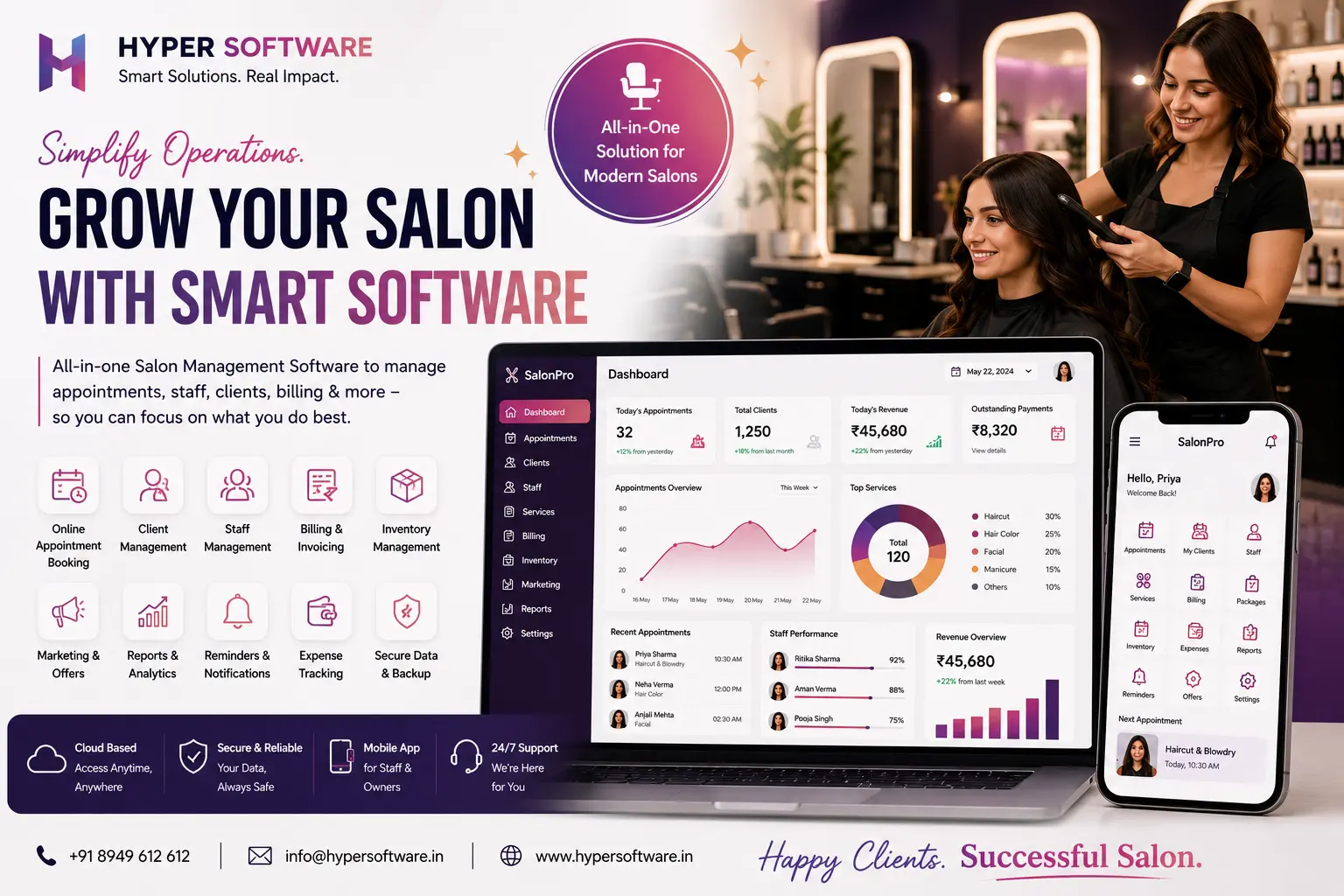
Salon management software is a single system that replaces your appointment register, billing counter, and client notebook with one dashboard. It handles online bookings, billing, staff schedules, inventory, and client history — so you're not running five different tools to manage one salon.
If you're still confirming appointments over WhatsApp, calculating stylist commissions on paper, or guessing which shampoo is about to run out, this guide walks you through exactly what to look for, what it costs, and how to get the right system running in your salon.
Salon management software is a cloud-based or on-premise system built specifically for hair, beauty, and wellness businesses to manage appointments, clients, staff, billing, and stock in one place.
It's different from a general booking app in one important way: it understands salon- specific workflows. It stores color formulas, tracks stylist commissions, manages retail inventory alongside service inventory, and lets clients rebook the same stylist without a phone call. A generic scheduling tool can block out time slots. Salon software runs the business behind those time slots.
Most modern platforms cover five things at minimum: online booking, a point-of-sale (POS) billing system, client relationship management (CRM), staff scheduling with commission tracking, and basic reporting. Anything calling itself "salon management software" but missing two or more of these is really just a booking tool wearing a bigger label.
Get Free Consultation Within Minutes
You don't need software the day you open. Most salon owners wait too long, not too little. Here's how to tell you've crossed the line:
If three or more of these sound familiar, manual management is already costing you more than a software subscription would.
Not every feature matters equally. Here's what actually moves the needle, based on what salons ask for most.
Clients should be able to see real-time availability and book a specific stylist without calling. This alone typically recovers bookings you'd otherwise lose to salons that answer the phone faster.
Every visit, service, product used, and color formula should sit against the client's profile. When a stylist opens a client's file and instantly sees "last visit: balayage, formula 7N + 20 vol," that's the difference between a good experience and a forgettable one.
billing software development should take under a minute per client: services, retail add-ons, tips, and split payments in one screen, with a GST-compliant invoice generated automatically for Indian salons.
The software should track hours, shifts, leave requests, and commission splits automatically — including tiered commission structures, which most salons run and most cheap tools handle badly.
Every service that uses product should deduct stock automatically. You get a real-time view of what's running low before a stylist tells you they're out of developer mid-appointment.
Automated appointment reminders, rebooking prompts, and win-back messages for clients who haven't visited in 60+ days. WhatsApp reminders specifically tend to outperform SMS and email for Indian and Middle Eastern markets, where WhatsApp marketing is the default communication channel.
For salon chains, one login should show combined revenue, stock, and staff data across every branch — not five separate logins you have to check individually.
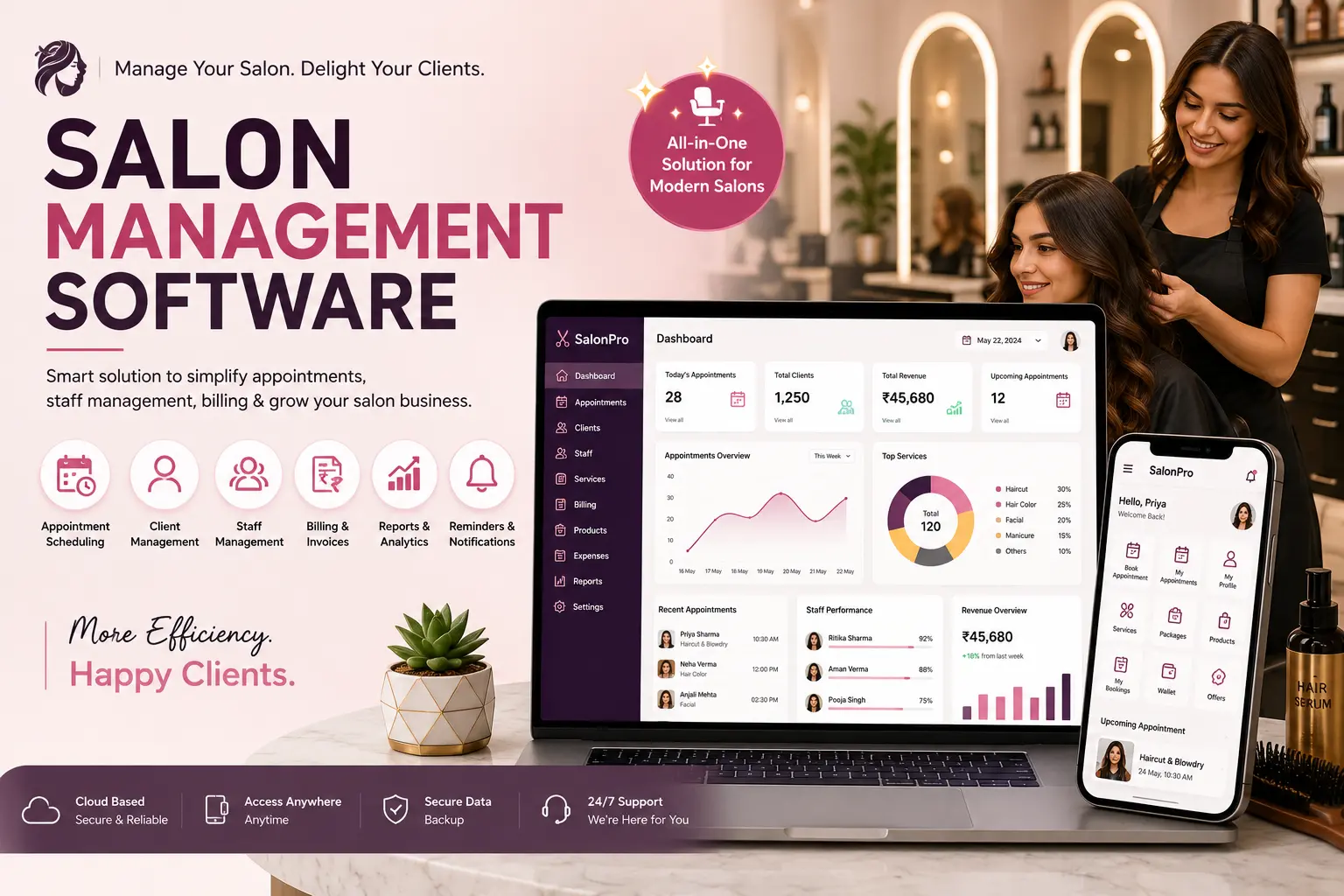
A two-branch salon in Jaipur came to us running both outlets on WhatsApp for bookings and a physical register for billing. The owner was manually reconciling cash at both branches every night and had no visibility into which branch was actually profitable.
We built them a custom salon management system with centralized booking, GST-ready billing, and a combined dashboard for both locations. Stock deductions were tied to each service so the owner could finally see real product cost per client. WhatsApp reminders replaced manual follow-up calls.
Within the first two months, no-shows dropped noticeably, evening reconciliation went from 45 minutes to under 10, and — for the first time — the owner could see which branch was carrying the other. That last part mattered more to her than any of the automation. She'd suspected it for a year and finally had the numbers to prove it.
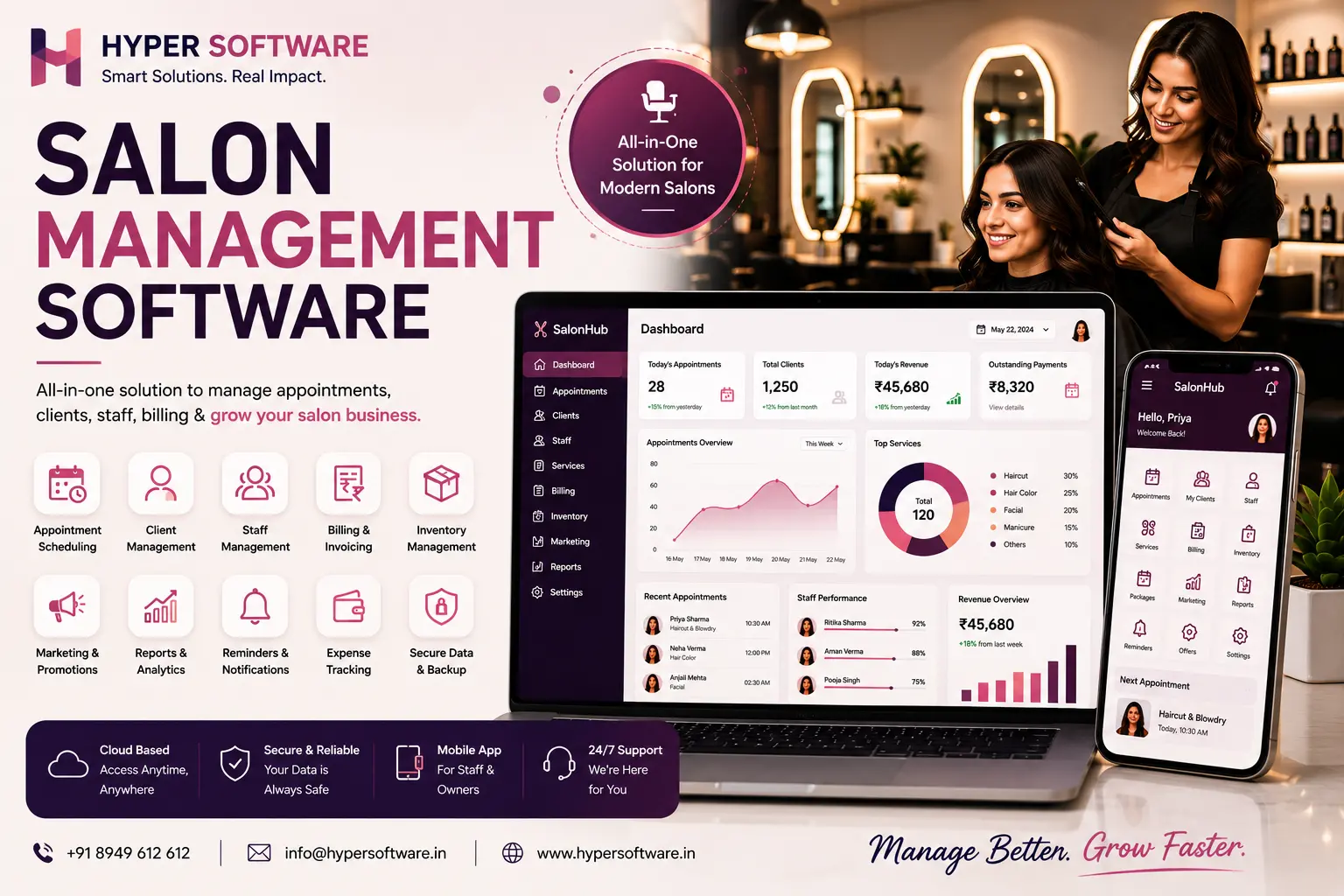
Should you cobble together free tools, buy an off-the-shelf subscription, or get something custom-built? It depends on where your salon is right now.
| Feature | DIY (Spreadsheets / Free Tools) | Ready-Made SaaS | Custom-Built (Hyper Software) |
|---|---|---|---|
| Best for | Single stylist, just starting out | Single salon, standard needs | Multi-location, specific workflows, or fast-growing businesses |
| Upfront cost | ₹0 | Low to none | Higher, one-time investment |
| Ongoing cost | Your time | ₹800–₹15,000+/month; per-staff or per-branch fees often add up | No per-seat or per-branch fees |
| Common challenges | Double bookings, no client history, manual errors increase as you grow | Paying for unused features; switching later often requires re-entering client data | Longer implementation time; requires a clear project brief |
| Data ownership | Yours, but unstructured | Vendor-controlled; export is possible but may require extra effort | Fully owned by you |
If you're a solo stylist with one chair, a free scheduling tool is genuinely fine for now. Once you're running two or more stylists, or two or more branches, the per-seat and per-branch fees on SaaS platforms usually cost more over three years than a custom build — and you're still locked into someone else's roadmap.
Ready-made platforms in India typically start around ₹800–₹2,000/month for a single outlet with basic features, rising to ₹4,000–₹15,000/month for multi-location plans with marketing automation and AI-driven insights. Globally, published pricing ranges from roughly $20/month for solo-stylist tools up to $175+/month for full-suite platforms, with enterprise chains often on custom quotes.
Watch for the real cost, not just the headline number. Per-staff login fees, WhatsApp/SMS message charges, and payment-gateway fees typically push actual monthly spend 1.5–2.5x above the advertised price.
Custom-built software has a higher one-time cost — generally a few lakh rupees for a single-salon system, scaling up for multi-branch or franchise-level builds with modules like loyalty programs, a branded client app, or medspa-specific consent-form tracking. There are no recurring per-seat fees, and you own the source code outright.
Work through this checklist before you sign anything:
Online booking, billing/POS, client CRM with service history, staff scheduling with commission tracking, and inventory management are the five core features every salon should have.
Yes, most full- featured salon management systems offer a centralized dashboard showing bookings, staff, revenue, and stock across all branches from a single login.
A booking app mainly handles appointment scheduling. Salon management software adds billing, staff commission tracking, inventory management, and client history on top of booking.
A properly built salon management system for the Indian market generates GST-compliant invoices automatically at the time of billing, without manual calculation.
A ready-made SaaS plan can be live within a day. A custom-built system typically takes a few weeks, depending on the number of branches and how much data needs migrating.
Yes, most salon management systems calculate commission automatically based on services performed, including tiered or product-based commission structures.
This depends on the provider. Reputable platforms allow data export; always confirm this before signing up, since some vendors make migration deliberately difficult.
It depends on your size. Subscriptions suit single salons with standard needs. Custom-built software suits multi- location salons or those with specific workflows, since it avoids per-seat and per-branch fees over time.
Yes, automated appointment reminders sent via SMS, WhatsApp, or email are one of the most effective features for reducing no-shows, since most no-shows happen simply because clients forget.
Yes, a full salon management system tracks both — deducting backbar product used during services and retail stock sold to clients — from the same inventory count.
Mostly, no — the underlying system is the same. What changes is configuration. Barbershops often need walk-in queue management alongside appointments, since many run a hybrid model. Spas typically need longer service-duration blocks and package/membership tracking. Medspas need consent-form storage and before/after photo tracking tied to each client. A well-built custom system handles all three by adjusting settings, not by requiring three different products.
Salon management software is a system that combines appointment booking, billing, client records, staff scheduling, and inventory tracking into one platform for hair, beauty, and wellness businesses.
Ready-made plans typically range from ₹800 to ₹15,000 per month depending on features and number of branches, while custom-built software has a one-time development cost with no recurring per-seat fees.
For one chair with no staff, a free or low-cost booking tool is usually enough. It becomes worth paying for once you're managing two or more stylists or need client history and billing in one place.
Yes, most modern salon software supports automated WhatsApp reminders for appointments, which typically get opened faster than SMS or email, especially in India and the Middle East.
Yes. Barbershops use the same core system as salons, usually with walk-in queue management added since many barbershops run a mixed appointment-and-walk-in model.
Have questions or need expert guidance? Our team is ready to help you with the right technology solutions for your business.